

The Polite Prompt Advantage: Why Speaking Respectfully to AI Gets You Better Results
What Every Solopreneur Needs to Know About Prompt Tone and AI Output Quality
Most solopreneurs think prompt quality is about structure - the right keywords, the right format, the right context. But there's a layer most people completely overlook: tone.
A new survey from Talker Research found that 86% of office workers say "please" and "thank you" to AI tools, with 27% doing it every single time. More striking: a meaningful share of respondents say politeness literally improves the quality of what they get back. That's not superstition. Tone and context shape what language models return.
Here's what this means for solopreneurs in 2026 - and how to use it deliberately:
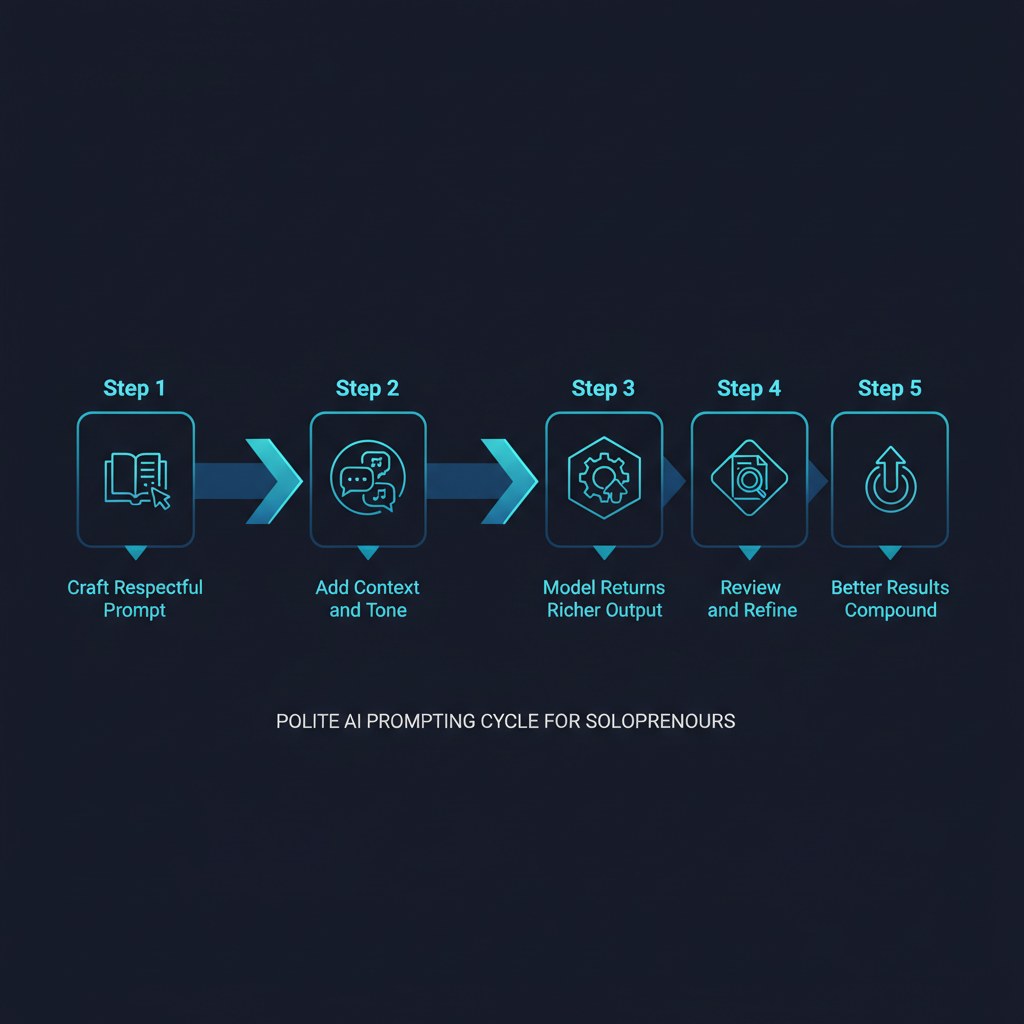
- Tone as a context signal - how you frame a request influences what the model thinks you need
- Politeness as a framing device - courteous phrasing tends to invite more thorough, collaborative responses
- Conversational rhythm - treating AI like a professional partner changes the cadence of your outputs
- Consistency and reliability - a stable, respectful prompting style produces more predictable results over time
- The compounding effect - small refinements in how you speak to AI build into significant quality gains across hundreds of interactions
Before you dismiss this as soft science, consider: the people consistently extracting top-tier results from AI tools aren't just better at structure. They've developed a relationship with how they communicate.
AI Productivity Daily has tracked, tested, and covered AI prompting behavior across dozens of tools and use cases since 2024. In this guide, I'll break down what the research actually says, how tone functions technically within modern language models, and give you a practical prompting framework you can start using today.

The Research Landscape: How Tone Shapes AI Behavior in 2026
The Talker Research survey isn't an isolated data point. It reflects something practitioners have observed for years: the social register of your prompts influences the register of the model's response.
According to Talker Research, 64% of workers believe common courtesy matters when talking to AI, and 64% would consider AI a coworker someday. C-suite leaders embrace AI at 93% versus 70% for frontline staff - and those leaders expect AI to be treated like a coworker within six years. That behavioral shift is already happening at the top of organizations. As a solopreneur, you're both the leader and the frontline - so you're navigating both roles at once.
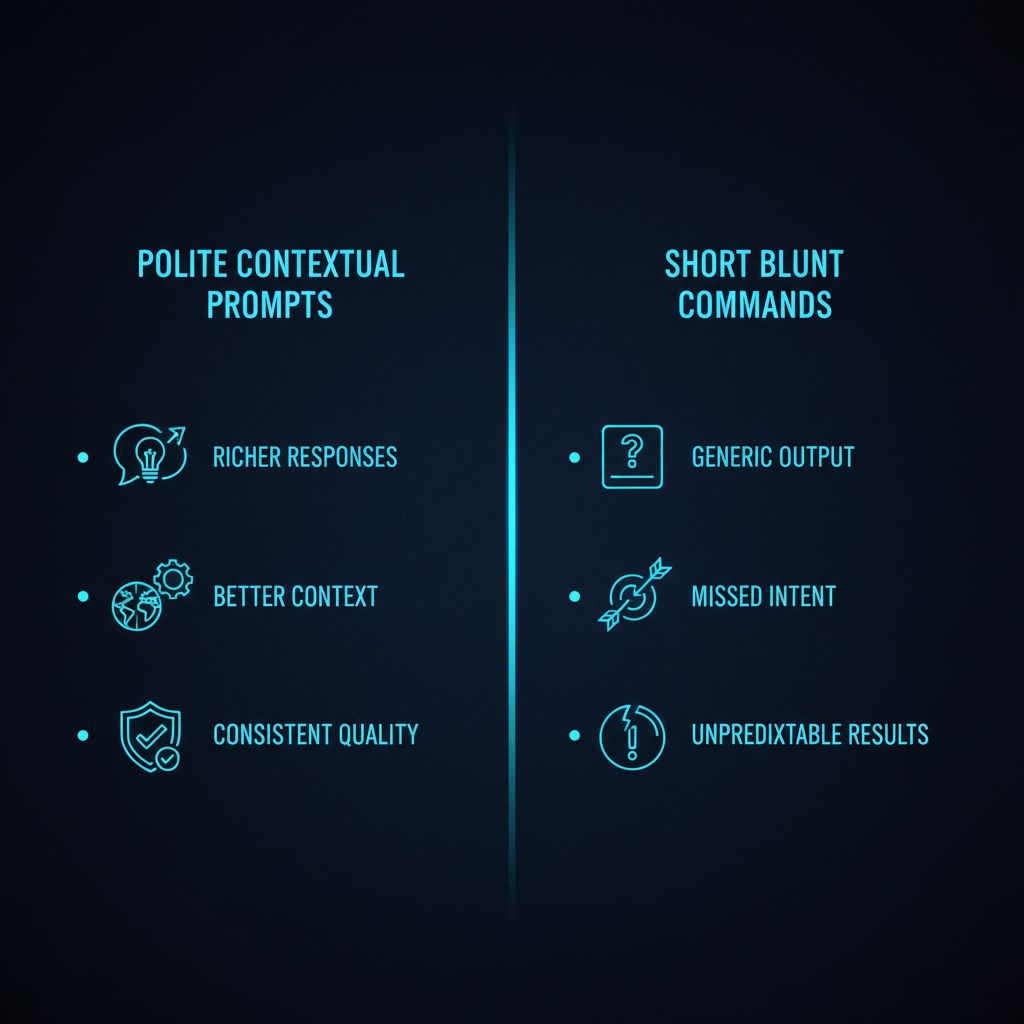
In 2026, the most widely used AI tools - ChatGPT, Claude, Gemini, Perplexity - are all trained on vast amounts of human conversation. That training creates a learned sense of "what usually follows." Polite, professional framing tends to precede thoughtful, detailed responses in the training data. Blunt, command-style framing tends to precede terse, functional replies.
The Mechanics of Tone as a Context Signal
Language models process your prompt holistically. When you write "Could you help me think through the best approach to restructuring my service offerings?" versus "List restructuring options," you're not just changing the format - you're changing the implied audience and the implied relationship.
The first prompt signals:
- The responder is a collaborative partner, not a lookup tool
- The asker values reasoning, not just output
- There's nuance to consider, not just a checklist to produce
These signals shape the response in measurable ways. You're more likely to get nuanced analysis, caveats, alternative framings, and strategic considerations - exactly what a solopreneur making real business decisions needs.
How C-Suite Adoption Is Changing the Norms
The 93% AI adoption rate among executives (versus 70% for staff) points to something important: leaders are treating AI like a high-level advisor, not a search engine. That framing - advisor, not tool - changes how they prompt. They ask for recommendations. They share context. They respond to outputs with follow-up questions.
That behavioral pattern produces better results, which reinforces adoption. As a solopreneur, you're already in that mindset by necessity. Lean into it.
How to Choose the Right Prompting Register for Your Business Tasks
Not every task calls for the same tone. Here's a practical framework for matching your prompt register to the output you actually need:
| Task Type | Prompt Register | Key Quality | Best For | |---|---|---|---| | Creative ideation | Conversational + curious | Opens up options, invites unexpected angles | Brainstorming, naming, positioning | | Strategic analysis | Professional + contextual | Invites reasoning, tradeoffs, caveats | Decisions, planning, risk review | | Structured output | Clear + directive | Precision, format compliance | Templates, tables, checklists | | Deep research | Collaborative + thorough | Encourages synthesis, sourcing | Reports, competitive analysis | | Quick lookups | Direct + specific | Speed and concision | Facts, definitions, quick edits |
The rule of thumb: the higher the stakes of the output, the more relational your prompt should be. A quick lookup doesn't need please and thank you. A strategic plan for your next product launch does.
The Talker Research data reinforces this - the workers who say politeness improves their results aren't adding pleasantries to every query. They've internalized that certain types of work warrant a different register, and they've applied that judgment.
The Solopreneur Anxiety About "Wasting Words" - Practical Tips
Many solopreneurs default to terse prompts because they worry about efficiency. Context feels like overhead. Here's how to reframe:
- Front-load your role and stakes - "As a solo service business owner preparing a proposal for a healthcare client, help me…" takes 12 seconds to type and can save 20 minutes of back-and-forth. In 2026, tokens are cheap. Your time isn't.
- Treat your first message as a briefing - Give the AI the same context you'd give a smart freelancer you just hired: who you are, what you need, what success looks like, and what constraints matter.
- Acknowledge and redirect - When a response misses the mark, say so clearly but constructively: "This is close, but I need something more focused on the emotional decision rather than the practical features." That framing gets better adjustments than "no, try again."
- Close strong loops - When an AI output is exactly right, say so and note why. Continuing the conversation with that acknowledgment sets up better follow-through in the same session.
For a full collection of prompt frameworks that apply these principles, see AI Productivity Daily's free tools library.
Directive vs. Collaborative Prompting - Understanding the Difference
Directive prompting is efficient and appropriate for well-defined tasks where you know exactly what you want and the output format is predictable. It's great for reformatting data, generating short-form copy variations, or running structured transformations.
Collaborative prompting trades a little efficiency for significantly higher quality on complex tasks. The tradeoff is worth it whenever the task involves judgment, ambiguity, competing priorities, or outputs you'll stake your business reputation on.
Polite Prompting for Every Stage of Your Solopreneur Journey
Where you are in your business shapes which prompting patterns matter most. Here's how the polite prompt advantage plays out across different stages:
- Early-stage solopreneurs (0-12 months) - You're figuring out your offers, your voice, and your positioning. Collaborative, exploratory prompting is invaluable here: "Help me think through how to position this service for someone who's never heard of me." You need AI to act like a thinking partner, not a producer.
- Growing solopreneurs (1-3 years, first team members or systems) - You're starting to delegate to AI more systematically. Relational prompting helps you build reliable workflows: "We've discussed my brand voice before - apply that same register here." Consistency compounds.
- Established solopreneurs (3+ years, proven offer) - You're optimizing for leverage. Here, the value of polite, contextual prompting is in depth - getting the AI to engage at the level of nuance your business decisions actually require.
Beginner vs. Advanced Options
Here's how prompting sophistication scales:
- Beginner (getting started): Start by adding one sentence of context before every request. Who you are, what this is for. That single change will noticeably improve output relevance within days.
- Intermediate (building habits): Develop 3-5 "anchor prompts" - pre-written context blocks you paste at the start of different task types. One for client emails, one for content, one for strategy. Saves time, improves consistency.
- Advanced (systematic leverage): Build system prompts or custom instructions in your AI tools that encode your context, voice, preferences, and typical tasks. Your AI now starts every session already briefed. This is the multiplier solopreneurs with mature AI practices are using in 2026.
Customization and Workflow Integration
The 2026 landscape offers more customization than ever. ChatGPT's custom instructions, Claude's Projects, and Gemini's context windows all allow you to encode your professional context once and benefit from it across every interaction:
- Set a persistent professional context - Your industry, your business model, your audience, your tone. This turns politeness from an active choice into a default.
- Create task-specific workflows - A "client email" workflow that always starts with your voice and value proposition baked in means you don't have to re-brief every time.
- Integrate feedback loops - When something works well, document it. Build a personal prompt library that grows with your practice.
Why This Matters for Solopreneurs Running Lean in 2026
Most solopreneurs don't have a team to filter and refine AI outputs before they go to clients. Everything that comes out of your AI workflow reflects directly on you. That makes output quality not a nice-to-have but a competitive necessity.
The research is pointing at something that experienced AI practitioners already know: the way you engage with AI isn't just a technical variable. It's a quality variable. Solopreneurs who treat their AI tools like capable professionals - with context, with respect, with clear expectations - consistently outperform those who treat them like vending machines.
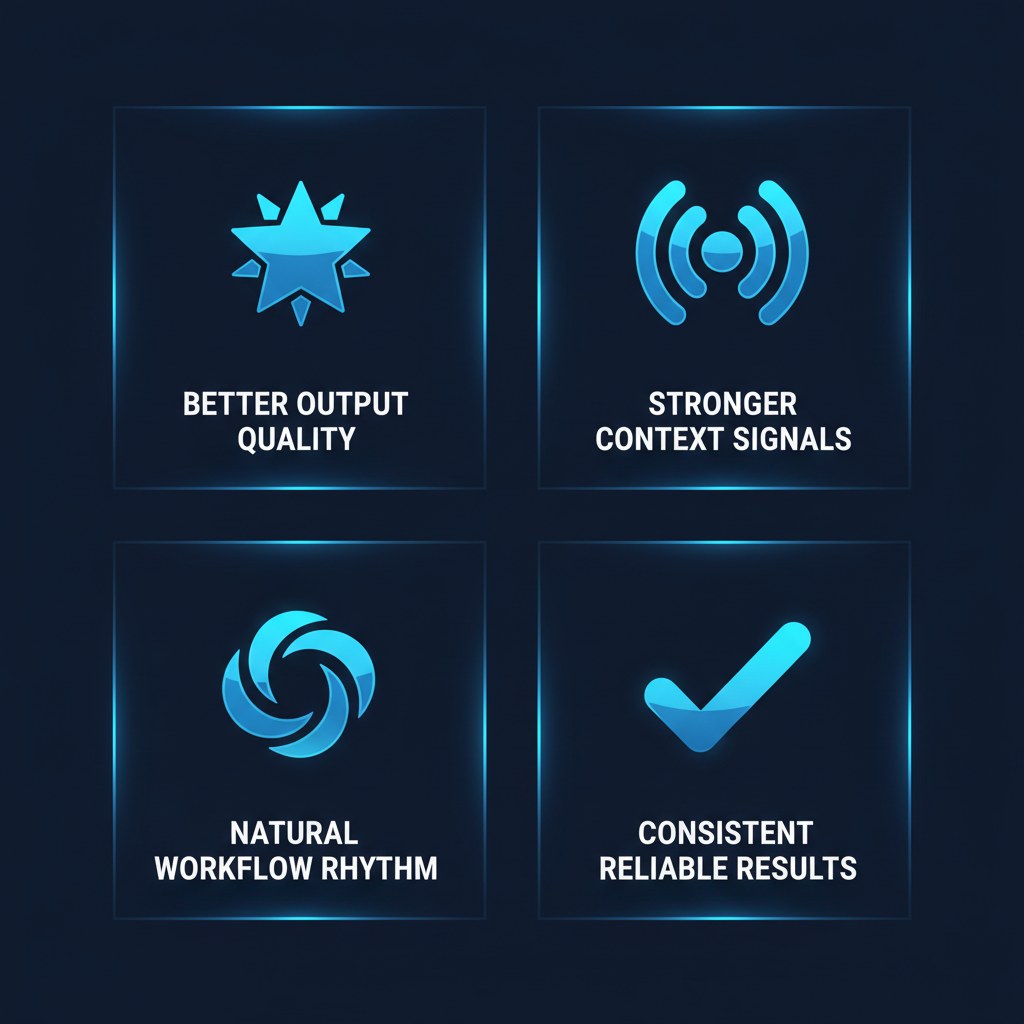
- Better output quality - Polite, contextual prompts produce responses that require less editing and better match the intended use
- Stronger context signals - Tone communicates intent; the model understands what kind of response is expected
- Natural workflow rhythm - Treating AI as a collaborator creates a conversation flow that's easier to iterate within
- Consistent, reliable results - A stable prompting register reduces variance in outputs, which matters enormously when you're working at volume
Getting the Most Out of Your Prompting Practice
These four habits will sharpen your results faster than any other single change:
- Brief before you ask - One sentence of context before every substantive request. Not every trivial query needs it, but any task where quality matters does.
- Describe the reader, not just the task - "Write this for a skeptical CFO who's seen a hundred pitches" produces fundamentally different output than "write a pitch." The model needs to know who you're trying to reach.
- Iterate with respect - When refining an output, frame the correction as additional context, not as a failure: "Let's take this in a more conversational direction" versus "This is too formal, rewrite it." The first framing tends to produce better adjustments.
- Acknowledge what worked - When a session produces exactly what you needed, note it before moving on. "That framing was perfect - keep that register as we move to the next section." This reinforces the pattern within the conversation.
For more prompting tools and templates built specifically for solopreneurs, visit AI Productivity Daily's free tools page.
Frequently Asked Questions About Prompt Tone and AI Output Quality
Does being polite to AI actually change what it produces, or is this just psychology?
Both, and that's the point. Modern language models are trained on human conversation, so polite, professional framing signals "this is the kind of exchange that warrants a thoughtful, detailed response." The tone you use is functional context, not just courtesy. Separately, the habit of writing more carefully when you're being polite also tends to produce better-specified prompts - which further improves results. The two effects compound.
How do I apply polite prompting without slowing down my workflow?
Start with templates. Create three or four prompt starters - one for strategy tasks, one for content, one for client communication - that already have your context and a collaborative tone built in. That way, you're not writing from scratch every time. Over time the pattern becomes automatic. Most experienced solopreneurs report that polite, contextual prompting actually saves time by reducing the revision cycles that terse prompts create. In 2026, the tools also remember context within projects, so you invest in the briefing once and benefit from it across many sessions.
Can I build this habit if I've been prompting bluntly for years?
Yes, and the payoff is immediate. Pick one type of task you use AI for regularly - maybe client email drafts or weekly planning. For one week, apply the "brief before you ask" principle to that task type only. Add one sentence of professional context before each request. Review the difference in quality and revision time at the end of the week. That single change in one task type is usually enough to demonstrate the value and make the habit stick.
Conclusion
The research confirms what the best practitioners already knew: how you talk to AI shapes what you get from it. Not because AI has feelings, but because tone is information. It signals intent, relationship, and expected output register - all of which language models respond to in measurable ways.
For solopreneurs, this is a genuine competitive advantage that costs nothing to develop. You're already making high-stakes decisions about how you invest your time. A small, deliberate shift in how you prompt - more context, more clarity, more collaboration - compounds into significantly better outputs across every use case that matters.
Start with the free AI Morning Brief at aiproductivitydaily.com/free-tools - a daily digest of what's moving in AI, filtered for solopreneurs. It's the fastest way to stay current and keep your prompting practice sharp.
One AI workflow, every weekday.
Tutorials, tool reviews, and automation playbooks for solopreneurs running on AI. Short, useful, and free. Unsubscribe anytime.
No pitch. No upsell. One quick AI workflow per weekday.