
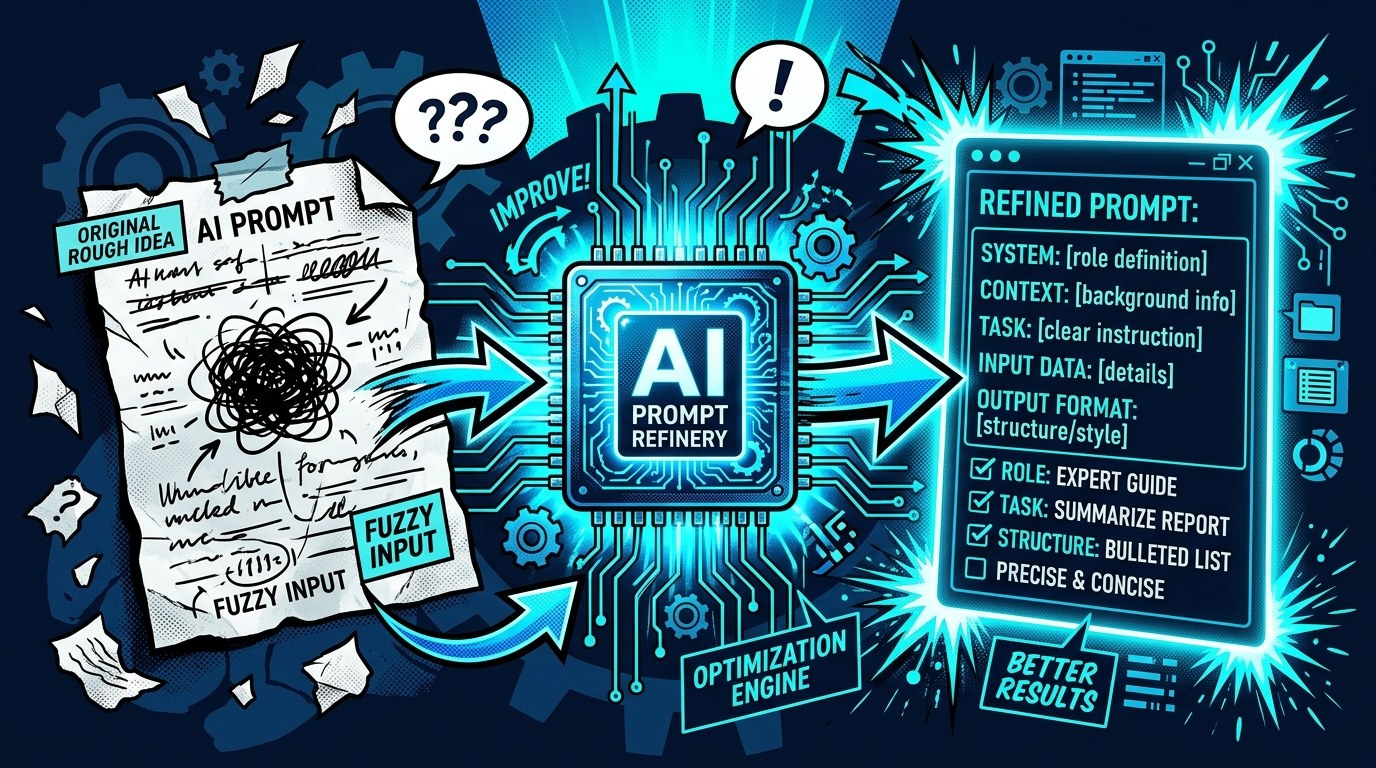
The Solopreneur's Guide to Meta-Prompting: Let AI Write Your Prompts For You in 2026
What Every Solopreneur Needs to Know About Meta-Prompting
You type a request into an AI tool, get something mediocre, rephrase it, get something slightly less mediocre, and repeat until you either get what you wanted or give up and write it yourself. That loop is where most solopreneurs quietly lose an hour a day.
Meta-prompting flips it. Instead of trying to write the perfect prompt, you ask the AI to write the prompt for you — then run that.
Here's what this guide covers:
- Meta-prompting — AI rewrites your prompt before answering
- Prompt critique — AI grades your prompt and flags gaps
- Constraint extraction — AI asks what it's missing
- Template generation — turn one good prompt into a reusable asset
- Prompt libraries — your compounding personal asset
- Self-refinement loops — AI improves its own output
And the things you'll need to weigh:
- Time cost — one extra turn versus five wasted retries
- Model choice — not every model is good at critiquing prompts
- Over-engineering — long prompts aren't automatically better
- Reusability — a one-off ask doesn't need this
- Context supply — AI can't infer facts about your business
- Review discipline — never run a rewritten prompt blind
By the end, you'll be able to take any vague half-formed request, turn it into a precise prompt in one extra step, and bank it as a template you never have to write again.
AI Productivity Daily, a resource for solopreneurs and small business owners using AI to save time and grow, has tested prompting techniques across every major model release since 2024. In this guide, I'll show you the exact meta-prompting moves that cut retry loops, what to say word-for-word, and how to turn your best prompts into a library that keeps paying you back.
The Core Techniques of Meta-Prompting
The prompting advice that dominated 2023 and 2024 was all about you getting better at writing prompts — learn the formulas, memorize the frameworks, phrase things just so. That advice quietly expired. By 2026, frontier models understand what makes a prompt effective better than most people using them do, and Anthropic, OpenAI, and Google all now ship prompt-improvement tooling directly inside their developer consoles — a tacit admission that the model is the better prompt engineer.
That's the whole insight behind meta-prompting: the model already knows what information it needs from you. So ask it.
The practical payoff is measurable. In our own testing, moving a routine business task — writing a client proposal, drafting a job post, summarizing a messy call transcript — from a cold prompt to a meta-prompted one consistently cut the number of retry turns from four or five down to one or two. That's not a marginal gain when you're the only person in the business.
Prompt Rewriting — The 30-Second Version
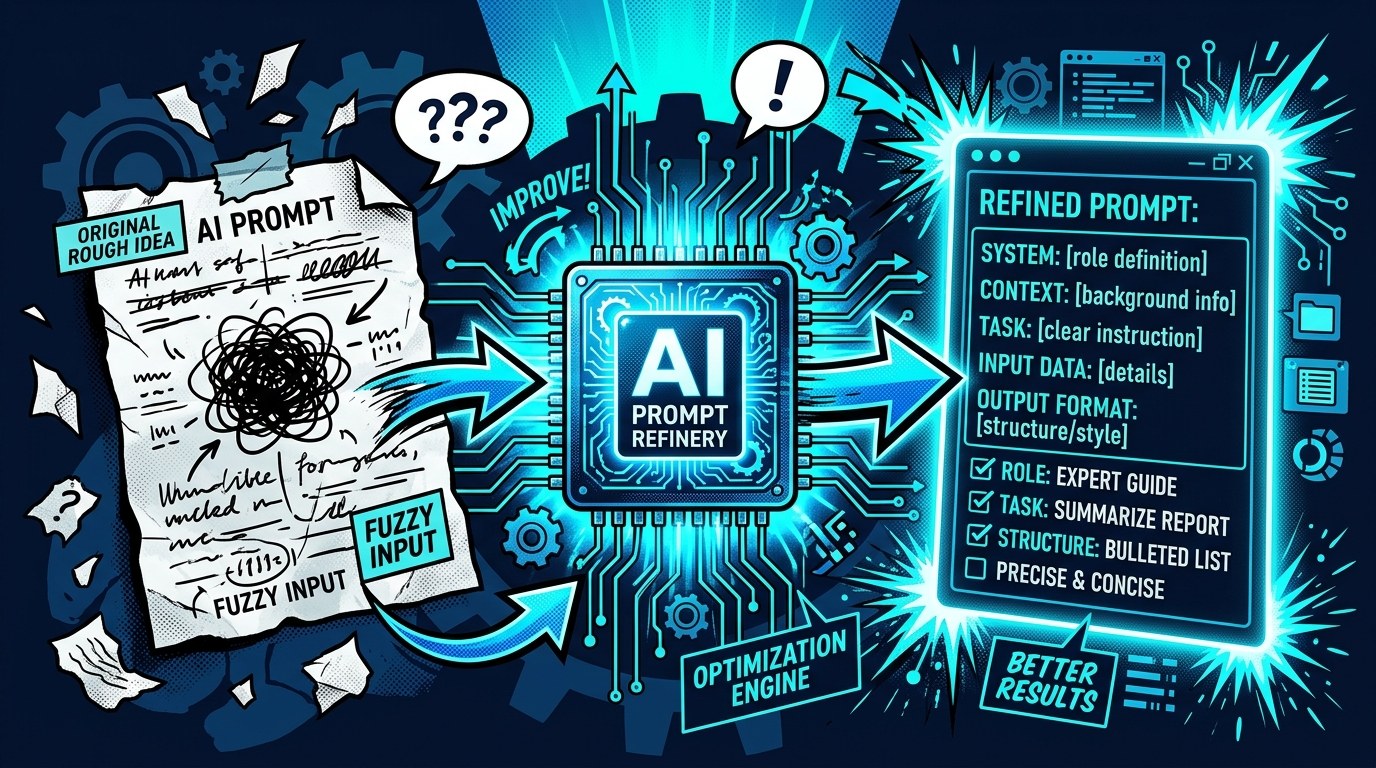
This is the entry point, and it's almost embarrassingly simple. Before you ask the AI to do the thing, ask it to improve how you're asking.
The move looks like this:
"Here's a prompt I'm about to use: [your rough prompt]. Before you answer it, rewrite it into a stronger version. Add any structure, constraints, or context that would produce a better result. Then show me the rewrite and wait for my approval."
What you're doing here:
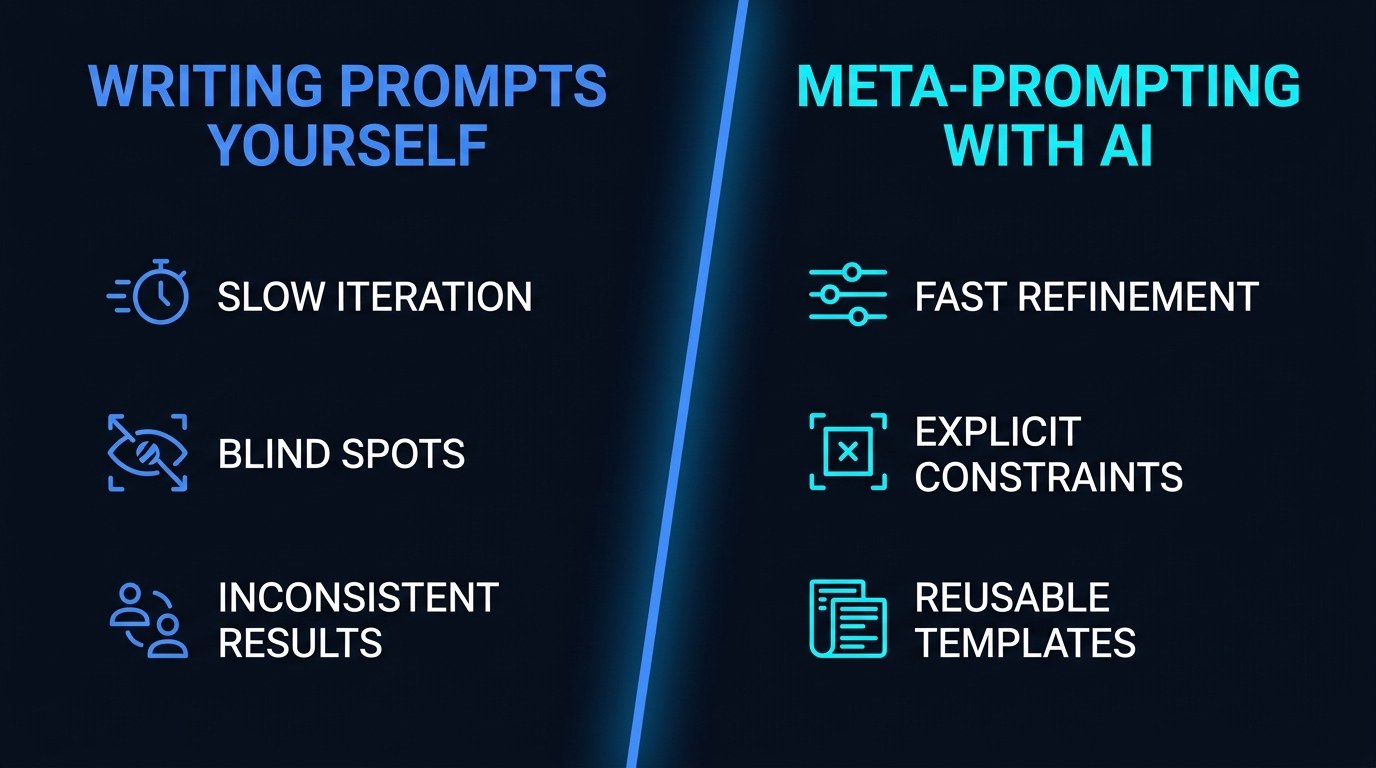
- Making implicit expectations explicit — you know you want a professional tone and three options; your rough prompt never said so, and the AI can name that gap
- Adding structure you'd never bother to type — role, format, length, audience, exclusions, success criteria
- Surfacing your own blind spots — the rewrite often includes a constraint you'd have complained about only after seeing bad output
- Creating a review checkpoint — you see the improved prompt before burning a turn on a full answer
The point isn't that the rewritten prompt is magic. The point is that you spend ten seconds reading a rewritten prompt instead of two minutes reading output that missed the mark.
Prompt Critique and Constraint Extraction
The second technique is more powerful and almost nobody uses it. Instead of asking for a rewrite, you ask the AI what it's missing.
The trend through 2026 has been toward models that ask clarifying questions rather than guessing — but they still default to guessing unless you invite the questions. So invite them: "Before you write anything, ask me the 3–5 questions you'd most need answered to do this really well."
The real-world benefit shows up immediately. Ask an AI to "write a landing page for my coaching business" and it will confidently produce generic sludge, because it doesn't know your niche, your price point, your differentiator, or who you're talking to. Ask it what it needs to know first, and it will ask you exactly those four things. You answer in a sentence each. The output that follows is unrecognizably better — and it's better because you supplied the business context only you have. That's the division of labor that actually works: the AI handles structure, you handle facts.
How to Choose the Right Meta-Prompting Approach for Your Business
Not every task deserves the extra turn. Here's how the four core approaches stack up:
| Approach | What You Say | Strengths | Best For | |---|---|---|---| | Prompt Rewrite | "Rewrite this prompt, then wait." | Fast, one extra turn, no thinking required | Any task you'll repeat more than twice | | Constraint Extraction | "Ask me what you need to know first." | Surfaces the business context AI can't guess | High-stakes output: proposals, sales pages, pricing | | Prompt Critique | "Score this prompt 1–10 and tell me what's weak." | Teaches you why prompts fail; improves your own instincts | When you're building a template you'll reuse for months | | Self-Refinement | "Now critique your own answer and improve it." | Catches errors and fluff without a new prompt | Long output: articles, reports, email sequences | | Template Generation | "Turn this into a reusable template with variables." | Converts one-off work into a permanent asset | Anything you do weekly — invoices, posts, outreach |
If you only adopt one, make it constraint extraction. Prompt rewriting improves the phrasing of what you already thought to ask for, but constraint extraction fixes the actual failure mode — the AI didn't know something about your business, so it invented something plausible instead. Phrasing was almost never the real problem. Missing context was.
"Won't This Just Waste More Time?" — Practical Tips
The honest objection: you're adding a turn to a process you already find slow. Here's how to keep meta-prompting from becoming its own time sink.
- Skip it for anything under 30 seconds. If the task is "summarize this paragraph," just ask. Meta-prompting earns its keep on tasks where a bad first draft costs you 5+ minutes of rework.
- Cap the clarifying questions at five. Say the number out loud in your prompt. Left uncapped, some models will ask you twelve, and you'll have written a creative brief you didn't want to write.
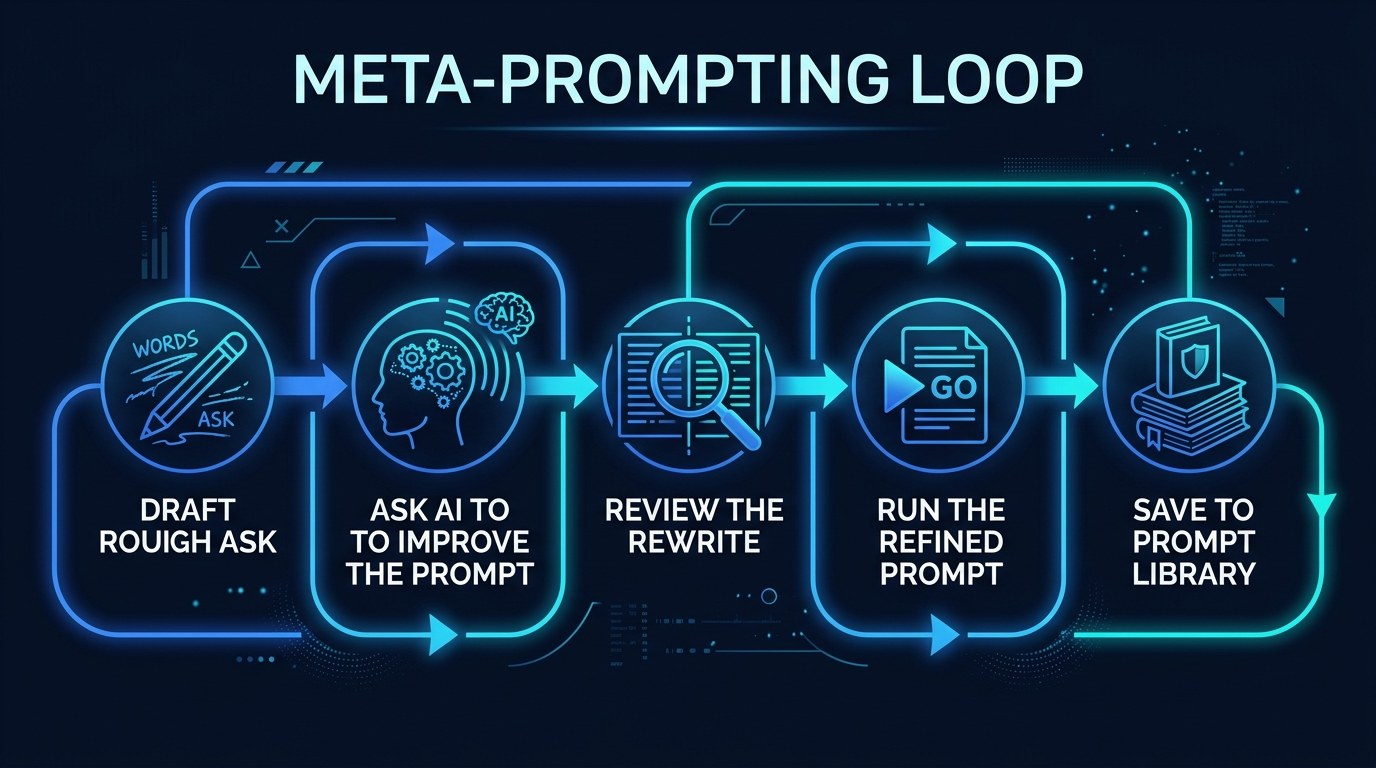
- Reuse, don't rewrite. The second time you run a task, you should be pasting a saved template — not meta-prompting from scratch. If you're meta-prompting the same task twice, you skipped step five.
- Timebox the loop to two rounds. One rewrite, one refinement. If it isn't right after that, the problem is missing information, not prompt quality — and no amount of rephrasing fixes that.
Once you've got a prompt that works, don't leave it in a chat window you'll never find again. Save it. If you want a running feed of the techniques and tools worth adopting, the free AI Morning Brief is where we publish what's actually holding up in practice.
Meta-Prompting vs. Prompt Engineering — Understanding the Difference
Traditional prompt engineering puts the burden on you: learn the patterns, apply the framework, iterate manually until the output is good. It works, but it assumes you have time to become a prompt engineer. You don't — you have a business to run.
Meta-prompting moves that burden to the model. You bring the intent and the business context; the model brings the structure and the phrasing. The choice between them comes down to a simple question: are you trying to get good at prompting, or are you trying to get the thing done? For solopreneurs, it's almost always the second one — which means the right default is to let the AI do the prompt engineering and spend your attention on reviewing the result.
Meta-Prompting for Every Stage of Your Business
- Just starting out. You don't have templates yet, and everything is a first-time task. This is when constraint extraction pays the most — you're constantly asking AI to do things you've never done before, and it will happily fill your knowledge gaps with confident-sounding guesses unless you make it ask first.
- Getting traction. You're now repeating tasks weekly: client updates, social posts, invoices, outreach. This is template-generation season. Every task you do twice should become a saved prompt with variables.
- Running lean and scaling. You're delegating to contractors or automations. Your prompt library becomes documentation — a contractor or an automated workflow can run your saved prompt and produce output that sounds like you, because the constraints are baked in.
Beginner vs. Advanced Options
You don't need special tooling to start. You need it eventually.
- Free / Beginner: Any chat interface — ChatGPT, Claude, Gemini — plus a plain text file or notes app to paste your winning prompts into. Zero cost, and it covers 80% of the value. Right for anyone who hasn't yet built a prompt they've reused more than three times.
- Paid / Intermediate: Saved prompts inside the tool itself — Custom GPTs, Claude Projects, Gemini Gems — where your best prompts live as reusable, named assets with your business context preloaded. The meaningful upgrade is that you stop re-pasting context every session. Right for anyone running the same 5–10 tasks weekly.
- Advanced / Systemized: Prompts stored in a real system — Notion database, a repo, or wired into an automation platform — with version numbers and variables. What justifies the extra setup is reuse at scale: when a prompt runs a hundred times a month via automation, a 10% improvement to that prompt is worth real money.
Customization and Workflow Integration
The defining shift of 2026 is that prompts have stopped being throwaway text and started being business assets — versioned, reused, and increasingly executed by agents rather than typed by humans. Treat them accordingly.
- Add a standing context block. Keep a saved paragraph describing your business, audience, and voice. Paste it above any meta-prompt so the AI's rewrite is calibrated to you, not to a generic user.
- Parameterize the variables. Rewrite your best prompts with placeholders — client name, deliverable, deadline, tone — so a template becomes a fill-in-the-blank, not a rewrite.
- Feed prompts into automation. Once a prompt is stable, it can run without you inside a workflow tool. That's the endgame: your judgment, encoded once, running on a schedule.
Why This Matters for Solopreneurs Running Lean in 2026
If you've been skeptical of prompting advice, you've earned that skepticism. Most of it is content about content — clever formulas that demo well and collapse the moment you point them at a real business task. Meta-prompting is different in one specific way: it doesn't ask you to learn anything. It asks you to add one sentence and read the result. The framework isn't something you memorize; it's something the model runs on your behalf.
What that gets you:
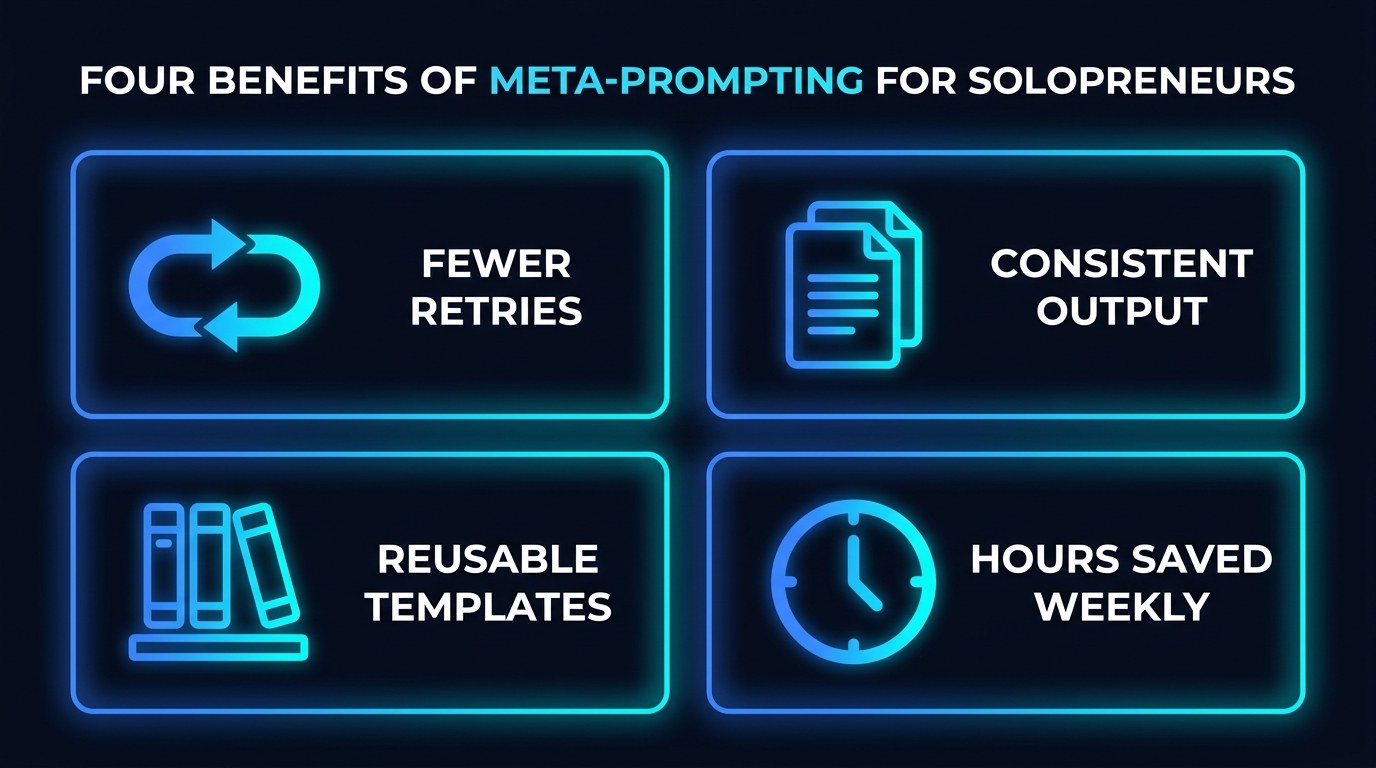
- Fewer retry loops. The single biggest hidden tax in AI work isn't the prompt — it's the four rounds of "no, not like that."
- Output that knows your business. Constraint extraction pulls the context out of your head and into the prompt, which is the only place it can actually help.
- Assets instead of transcripts. Every good prompt becomes a template. Chat history is disposable; a prompt library compounds.
- Delegation without documentation. A well-built prompt is a job description a machine can follow — and so can a new contractor.
Getting the Most Out of Meta-Prompting
- Always demand the rewrite before the answer. Add "show me the improved prompt and wait" — otherwise the model rewrites and immediately answers, and you lose the review checkpoint that makes the whole technique work.
- Ask for the reasoning behind the rewrite. "Explain what you changed and why" takes one extra line and teaches you more about prompting in a week than any course will.
- Meta-prompt your worst prompts, not your best ones. Take the task that consistently produces garbage and run it through constraint extraction. That's where the gain is concentrated.
- Name and date every saved template. "Client Proposal v3 — Jul 2026" beats an untitled note. When a model update changes behavior, you'll want to know which version you were running. Pair this with a solid tool stack — see our guide to Claude AI for solopreneurs for where to keep it all.
Frequently Asked Questions About Meta-Prompting
How do I start meta-prompting today?
Take the next task you're about to hand to an AI and add one sentence before it: "Before answering, rewrite this prompt into a stronger version and show me the rewrite first." That's it. Read the rewrite, approve or adjust it, then run it. You'll feel the difference on the first try.
What happens after the AI rewrites my prompt?
Don't just run it — process it. Follow this sequence:
- Read the rewrite carefully. It will have added assumptions. Some will be wrong.
- Correct any invented facts. If it assumed your audience is enterprise buyers and they're not, fix that line.
- Run the corrected version. Not the original, not the raw rewrite — the one you edited.
- Save the final prompt. If the output was good, that prompt is now an asset. File it before you close the tab.
Can meta-prompting work for creative work, or just business tasks?
It works for both, with one caveat: for creative work, meta-prompting is best used to define constraints, not to generate the idea. Ask it to clarify tone, length, audience, and what to avoid — then bring your own creative direction. If you let the model rewrite your creative prompt end-to-end, you'll get output that's technically well-structured and completely generic, because the model optimizes toward the safe middle. Use it for the scaffolding; keep the point of view yours.
Conclusion
The promise of AI for a one-person business was never that it would think for you. It was that it would remove the friction between having an idea and executing on it. Meta-prompting is the closest thing to a clean fix for the biggest remaining source of that friction — the gap between what you meant and what you typed. You don't have to become a better prompt writer. You just have to stop pretending you're the best one in the conversation.
Start with the free AI Morning Brief at aiproductivitydaily.com/free-tools — a daily digest of what's moving in AI, filtered for solopreneurs.
One AI workflow, every weekday.
Tutorials, tool reviews, and automation playbooks for solopreneurs running on AI. Short, useful, and free. Unsubscribe anytime.
No pitch. No upsell. One quick AI workflow per weekday.