

The Solopreneur's Guide to AI Agents: Automate Multi-Step Work Without Hiring in 2026
What Every Solopreneur Needs to Know About AI Agents
You have probably built a few automations already. They fire one step at a time — a form comes in, a row gets added, an email goes out. The moment a task needs judgment, though — read this, decide what it means, then do the right next thing — you are back in the driver's seat. AI agents are the piece that closes that gap: software that takes a goal, works out the steps on its own, and carries them out using the tools you already use.
Here is what this guide covers:
- What an AI agent actually is — goal-driven, not rule-driven
- Tool use and app access — agents that act, not just answer
- Planning and self-correction — steps figured out on the fly
- Memory across a task — context that carries between steps
- Human checkpoints — where you stay in control
- Guardrails and permissions — what an agent can and cannot touch
And here is what you actually need to weigh before you hand anything off:
- Which task is safe to delegate first
- How much autonomy you are comfortable granting
- What data and accounts the agent can reach
- Where a human must approve before anything ships
- What it costs to run at your volume
- How you will know the agent did the job right
By the end, you will know which kind of AI agent fits a one-person business, how to launch your first one this week, and where to keep a hand on the wheel.
AI Productivity Daily, a resource for solopreneurs and small business owners using AI to save time and grow, has tracked and tested AI agents across real client workflows all year. In this guide, I will show you where agents genuinely earn their keep, where they still need a human, and how to set one up so it saves you hours instead of creating cleanup work.

What an AI Agent Actually Is — and How It Differs From Automation
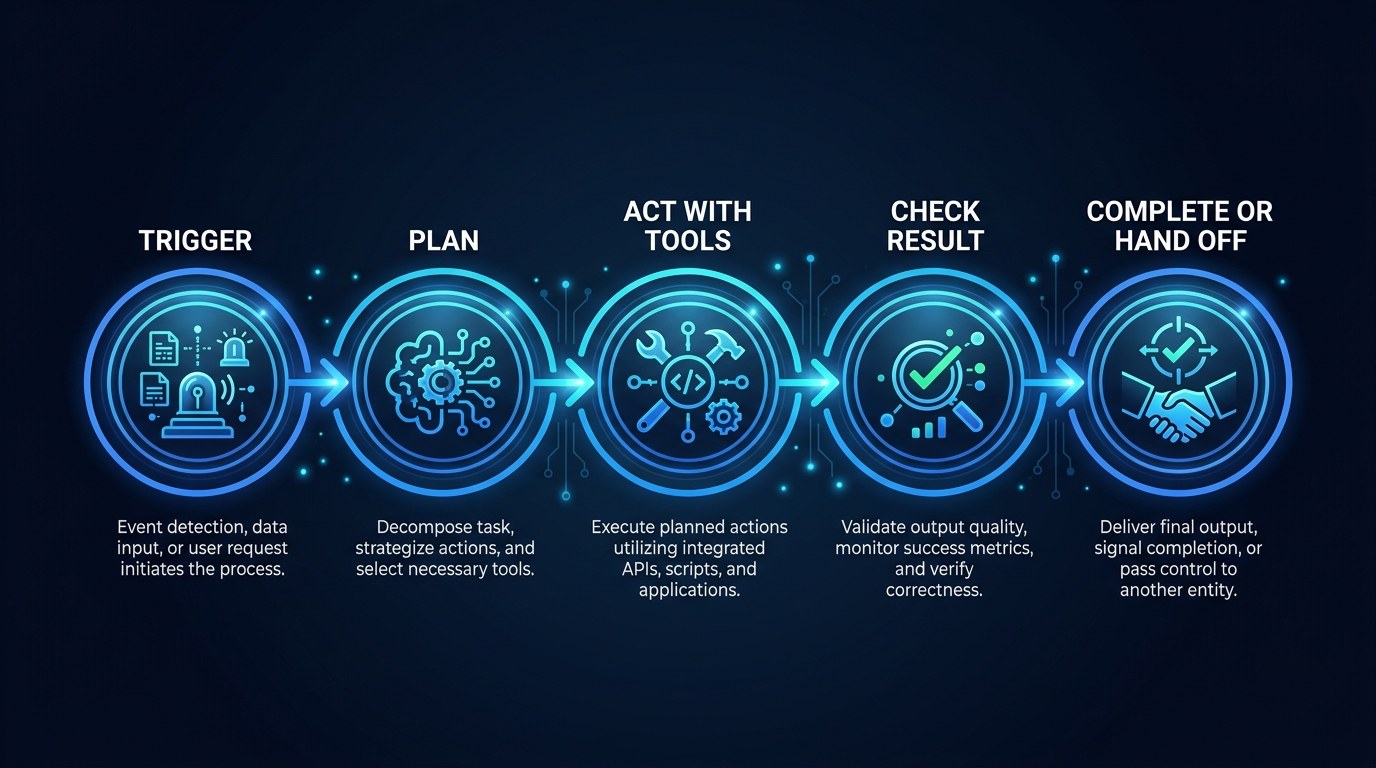
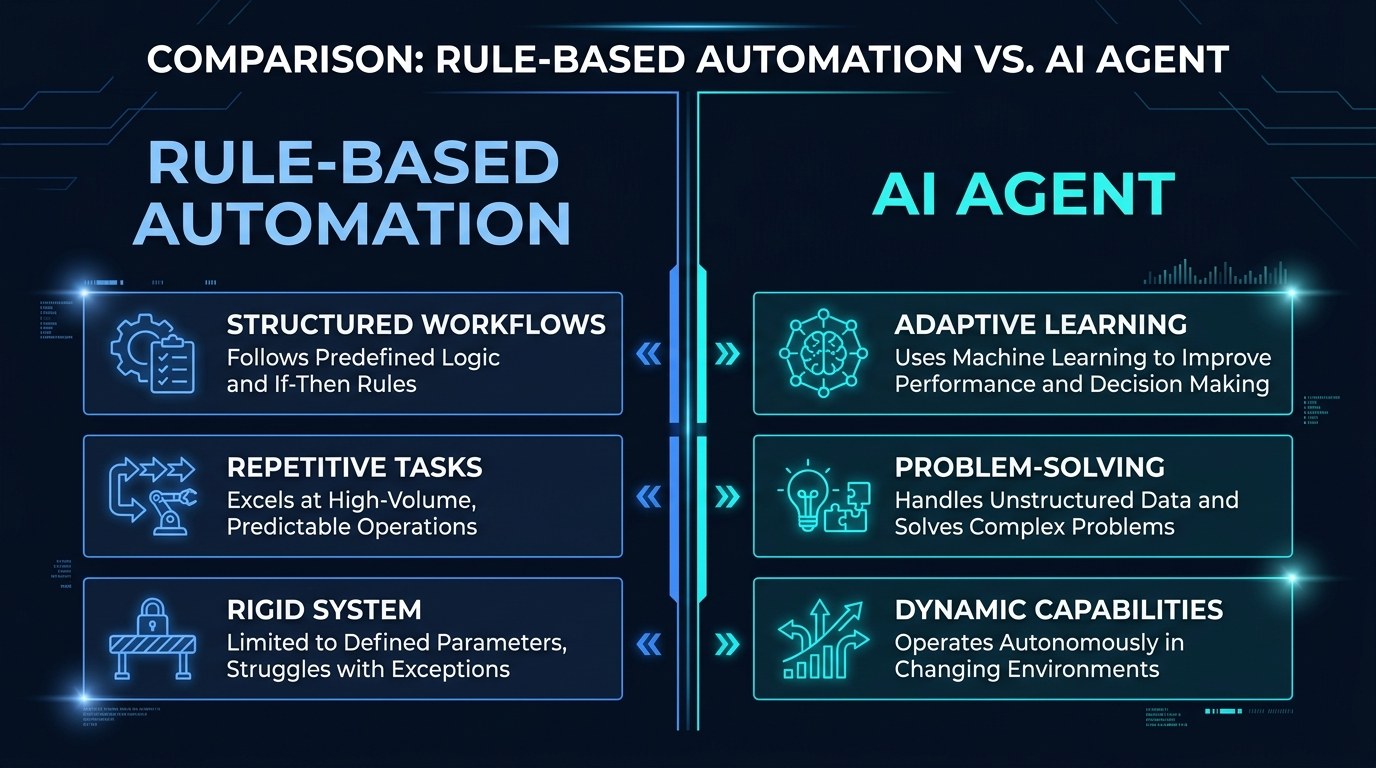
An AI agent is a system that you give a goal, not a script. Instead of you spelling out every step, the agent decides the steps itself: it reads the situation, makes a plan, uses tools or apps to act, checks whether it worked, and adjusts if it did not. A traditional automation follows a fixed path you drew in advance. An agent finds the path.
This is not a fringe idea anymore. Gartner projects that by 2028, 33% of enterprise software applications will include agentic AI, up from less than 1% in 2024 — and that roughly 15% of day-to-day work decisions will be made autonomously by agents. That shift is trickling straight down to solopreneurs in 2026, because the same agent tools that power big teams now come packaged in no-code builders anyone can use.
The Building Blocks of an AI Agent
Under the hood, every useful agent shares the same four parts. Understanding them tells you what to look for when you pick one.
- A goal — a plain-language outcome, like "sort new leads and reply to the good ones"
- Tools — the apps and actions it can reach, from your inbox to your CRM to a web search
- A reasoning loop — the ability to plan, act, check the result, and try again
- Memory — a way to hold context across steps so it does not lose the thread mid-task
When those four click together, you get something that feels less like a macro and more like a junior teammate who follows instructions and shows their work.
Why 2026 Is the Year Agents Got Practical
For years, "AI agent" meant a demo that broke the second you gave it a real job. That changed as models got better at using tools reliably and as platforms added guardrails you can actually trust. In 2026, the honest story is that agents are now dependable for narrow, well-defined jobs — and still shaky when a task is vague or high-stakes.
The practical benefit for a solopreneur is leverage. A single well-scoped agent can own a repetitive multi-step chore — qualifying leads, drafting first-pass replies, turning a call recording into a follow-up — and run it every time without you touching it. That is time back in your week, not a science project.
How to Choose the Right AI Agent Setup for Your Business
You do not need to code an agent from scratch. Most solopreneurs are better served picking the lightest setup that gets the job done. Here is how the main options stack up.
| Option | Key Quality | Strengths | Best For | |---|---|---|---| | No-code agent builders (Zapier AI, Make) | Fastest to launch | Visual, connects to apps you already use, no engineering | Your first agent and simple, well-defined tasks | | Workflow platforms with agent steps (n8n) | Flexible and low-cost | Self-hostable, mixes fixed steps with AI decisions | Owners who want control and lower per-run cost | | Chat assistants with tools (ChatGPT, Claude) | Easiest to supervise | Great for research-and-draft work with you in the loop | Tasks where you want to review before anything sends | | Purpose-built vertical agents | Zero setup | Pre-tuned for one job — support, scheduling, outreach | A single recurring need you would rather just buy | | Custom-coded agents | Fully tailored | Does exactly what you design, no platform limits | Advanced users with a unique, high-value workflow |
If you are choosing just one to start, pick a no-code agent builder and give it a task you already understand end to end. The reason is simple: you can only supervise an agent well on work you could do yourself, and a job you know cold makes it obvious when the agent gets it right — or wrong.
"What if the Agent Does Something Wrong?" — Practical Tips
That worry is healthy, and the fix is structure, not blind trust. Use these four rules to keep an agent on a short leash while it earns your confidence.
- Start read-only or draft-only. For the first 2 weeks, let the agent prepare work but require your click to send or publish.
- Scope one task, not your whole business. Give it a single job with clear inputs and outputs before you expand.
- Set a hard stop. Cap what it can spend, send, or change per run — for example, no more than 10 outbound emails a day.
- Review the log daily at first. Skim what it did each morning for a week; graduate it to less oversight once it is boring.
If you are still building the fixed-step automations underneath your agents, our guide to Zapier AI automation is a good place to get those foundations solid first.
Assistants vs. Agents — Understanding the Difference
An assistant answers when you ask. An agent acts when a trigger fires. That is the whole distinction, and it decides how much oversight you need. An assistant like ChatGPT waits for your prompt and hands work back to you, so you are always the final step. An agent runs on its own, so the guardrails have to live in the setup, not in your attention.
Which one you want depends on the task. If the work needs your judgment every time, keep it as an assistant. If the work is repetitive and the rules are stable, that is exactly what an agent is for.
AI Agents for Every Stage of Your Business
The right agent looks different depending on where you are. A few common starting points:
- Just launched — a lead-triage agent that reads inbound messages, tags the serious ones, and drafts a first reply so nothing sits unanswered.
- Growing steadily — an operations agent that turns finished calls into follow-up emails, CRM notes, and next-step reminders.
- Fully booked — a content or research agent that repurposes one piece of work into several, so your marketing keeps moving while you deliver.
Beginner vs. Advanced Options
You can grow your agent setup in stages instead of betting everything on day one.
- Beginner (free to low-cost): a single no-code agent doing one drafting or sorting task, with you approving every output. Right for anyone testing the water.
- Intermediate (paid tiers): two or three agents handling connected steps — intake, drafting, scheduling — with approval only on the parts that touch customers. Best once you trust the first one.
- Advanced (platform or custom): a small system of agents that hand work to each other, with logging and spending caps. Worth it when an agent is saving you real hours and the extra cost buys reliability.
Customization and Workflow Integration
The trend in 2026 is that agents plug into your existing stack instead of replacing it. You are not rebuilding your business around an agent — you are dropping one into a gap. Three ways to tailor an agent to how you actually work:
- Feed it your voice and rules — sample replies, your do-and-do-not list, your pricing — so its drafts sound like you.
- Connect only the apps it needs — grant access to the inbox or CRM for the task at hand, nothing more.
- Add a human checkpoint where it matters — route anything customer-facing or over a dollar threshold to you before it goes out.
Why This Matters for Solopreneurs Running Lean in 2026
If you have hesitated on agents because they sound like something a team with engineers sets up, that instinct made sense a year ago. It does not anymore. The barrier now is not technical skill — it is picking one task and scoping it tightly. Do that, and an agent quietly becomes the leverage a solo business almost never gets: help that does not need managing.
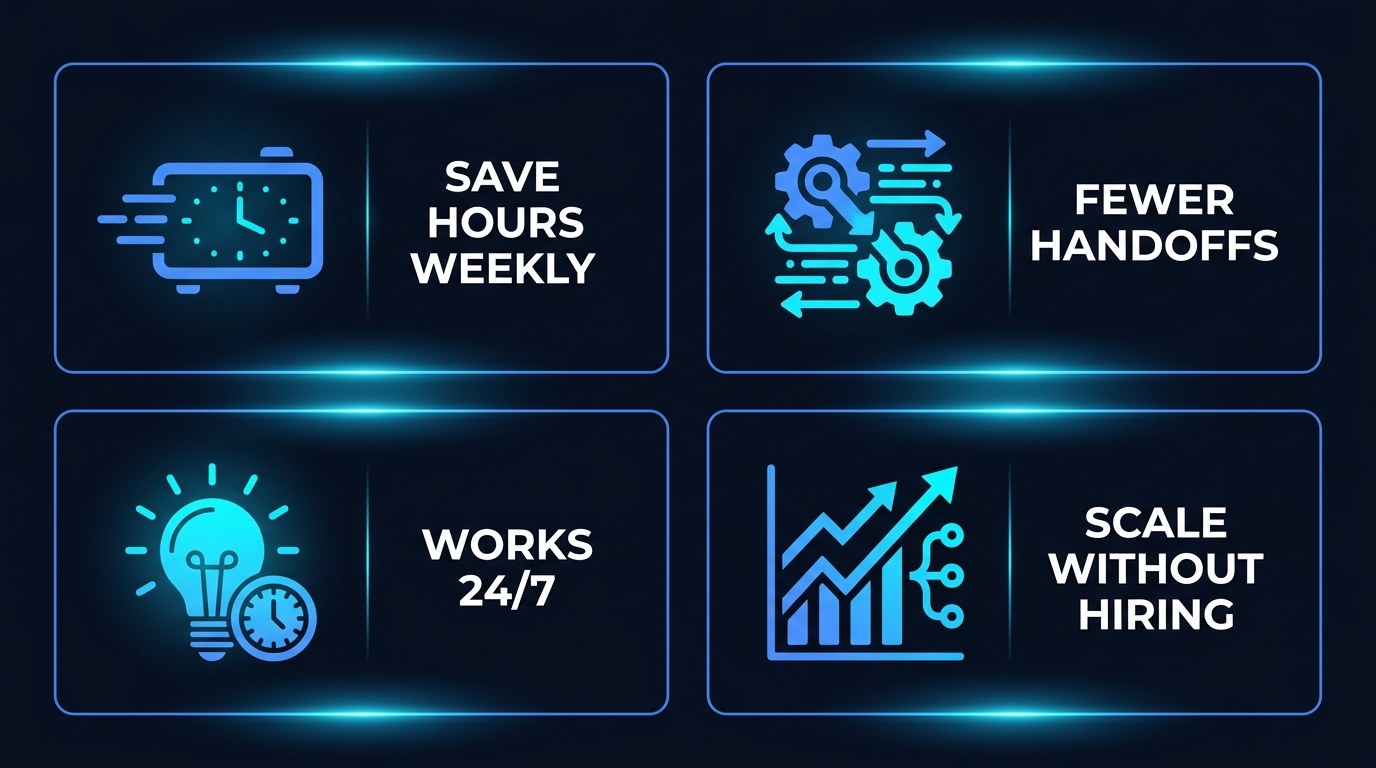
- Hours back every week — repetitive multi-step chores run without you.
- Fewer dropped balls — an agent does not forget the follow-up when you get busy.
- Coverage around the clock — leads and messages get a first response even while you sleep.
- Growth without headcount — you handle more volume without hiring for it.
Getting the Most Out of Your First AI Agent
- Pick a task you are sick of doing. Motivation is highest where the pain is real, and you will supervise it more carefully.
- Write the goal like you would brief a new hire. Spell out the inputs, the acceptable output, and the "never do this" list.
- Watch it work before you trust it. Run it alongside yourself for a few days so you catch its blind spots early.
- Expand only after it gets boring. Reliable and dull is the signal to hand it more, or to build the next one.
Once your first agent is steady, a workflow platform makes the next ones cheaper to run — our n8n automation guide walks through that step.
Frequently Asked Questions About AI Agents
How do I set up my first AI agent?
Start inside a no-code builder you already use, like Zapier AI or Make. Pick one repetitive task with clear inputs and outputs, write the goal in plain language, connect only the app it needs, and set it to draft-only so you approve every result. You can have a working first agent running in an afternoon.
What happens when an AI agent hits a task it cannot handle?
A well-built agent should stop and ask rather than guess. Set it up so that:
- It flags anything outside its instructions instead of forcing an answer
- It routes edge cases to you with a short note on what it was unsure about
- It logs what it tried, so you can see where it got stuck
- It never sends or spends past the limits you set when it is uncertain
Can I trust an AI agent with client data?
You can, with limits. Grant access only to the specific accounts a task requires, keep anything customer-facing behind your approval for at least the first few weeks, and review its activity log daily until it proves reliable. Treat access like you would with a new contractor: start narrow, widen slowly, and never hand over the keys to everything at once.
Conclusion
AI agents are not a leap into the unknown — they are the natural next step past the automations you already run. The skill is not coding; it is choosing one task, scoping it tightly, and keeping a hand on the wheel until the agent proves it deserves the slack. Do that once and you will feel the difference immediately: work that used to need you now just gets done, and your week has room in it again.
Want to stay ahead of what agents can do next without wading through the hype? Start with the free AI Morning Brief at aiproductivitydaily.com/free-tools — a daily digest of what is moving in AI, filtered for solopreneurs.
One AI workflow, every weekday.
Tutorials, tool reviews, and automation playbooks for solopreneurs running on AI. Short, useful, and free. Unsubscribe anytime.
No pitch. No upsell. One quick AI workflow per weekday.