

The Solopreneur's Guide to Prompt Frameworks: 5 Proven Templates for Better AI Results in 2026
What Every Solopreneur Needs to Know About Prompt Frameworks
You type a request into ChatGPT, get a mediocre answer, rewrite it, get something slightly better, and twenty minutes later you've burned the time you were trying to save. The problem usually isn't the AI — it's the prompt. A prompt framework is a repeatable structure that tells the model exactly what you want, so you get a strong answer on the first try instead of the fifth.
This guide covers the framework approaches that matter most for a one-person business:
- Role-based framing
- Task and outcome clarity
- Context and constraint setting
- Output format control
- Iterative refinement loops
- Reusable saved templates
Before you commit to any of them, here are the core considerations to weigh:
- How repeatable the task is
- How much context the model needs
- How specific your output format must be
- How much time setup will cost you up front
- Whether you'll reuse the prompt across clients or projects
- How much rework a vague prompt currently causes you
By the end, you'll have a small library of prompt structures you can paste, fill in, and reuse — turning AI from a slot machine into a dependable assistant.
AI Productivity Daily, a resource for solopreneurs and small business owners using AI to save time and grow, has tested these frameworks across writing, planning, and client work. In this guide, I'll walk you through the five that consistently produce better results and show you how to decide which one to reach for.

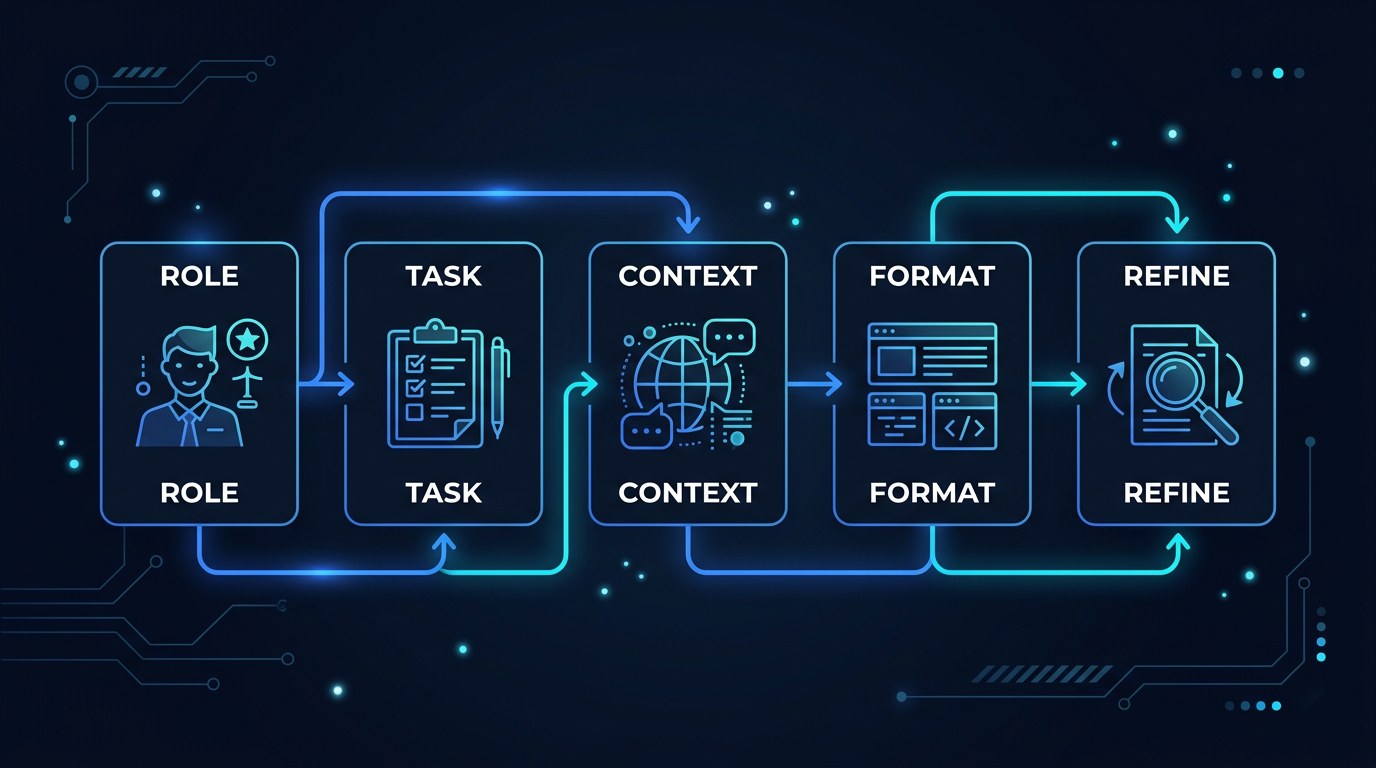
The Core Building Blocks of Effective Prompt Frameworks
Most prompting advice in 2026 still circles the same finding: clearer instructions beat clever tricks. A widely cited pattern across model providers is that prompts giving the model a role, a goal, and a format outperform one-line requests by a wide margin on real tasks. You don't need to memorize jargon — you need a structure you can repeat. Nearly every popular framework, from RTF (Role–Task–Format) to RACE (Role–Action–Context–Expectation), is just a different arrangement of the same handful of parts.
Role and Goal Framing
Telling the model who it should act as and what it's trying to achieve narrows its focus before it writes a single word. "You are a copywriter for a local fitness studio" produces sharper output than no framing at all, because the model pulls from the right patterns instead of averaging across everything it knows.
- Assign a clear role — name the expertise you want ("financial coach," "email strategist").
- State the goal up front — what the finished output is for, not just what it is.
- Set the audience — who will read or use the result.
When you frame role and goal first, every following instruction lands in the right context, and you stop getting generic, hedge-everything answers.
Context and Constraints
The second building block is giving the model the facts it can't guess and the limits it must respect. This is where most solopreneur prompts fall short — we hold the context in our heads and forget the AI can't see it.
Context means the specifics: your brand voice, the client's industry, what you've already tried. Constraints are the guardrails: word count, tone, what to avoid, what format to return.
A growing trend in 2026 is "context-first" prompting, where you paste a short brief — three or four lines about the situation — before your actual request. In practice this single habit removes most of the back-and-forth, because the model isn't filling gaps with assumptions. For a solopreneur juggling several clients, it's the difference between an answer you can use and one you have to rewrite.
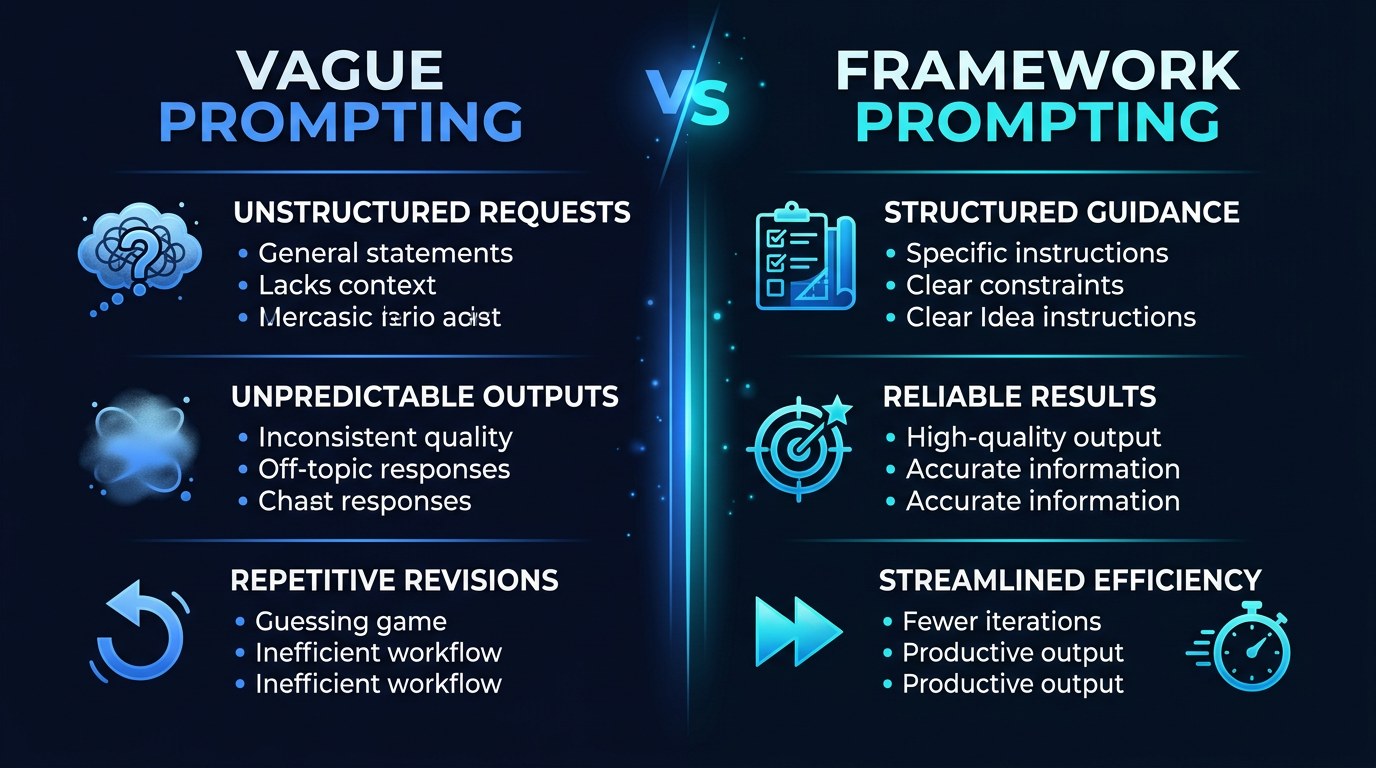
How to Choose the Right Prompt Framework for Your Business
Not every task needs the full treatment. Here's how the common frameworks stack up so you can match the structure to the job.
| Framework | Key Quality | Strengths | Best For | |---|---|---|---| | RTF (Role–Task–Format) | Fast and simple | Quick to type, good default | Everyday requests, drafts | | RACE (Role–Action–Context–Expectation) | Balanced | Adds context without bloat | Client work, emails | | CARE (Context–Action–Result–Example) | Example-driven | Great for matching a style | Brand-voice content | | Chain prompting | Sequential | Breaks big jobs into steps | Research, multi-part projects | | Saved templates | Reusable | Zero setup after first build | Recurring weekly tasks |
If you only adopt one, make it RACE. It adds just enough structure — context and a clear expectation — to fix the most common failure (vague output) without slowing you down, and it scales naturally as your tasks get more complex.
"I Don't Have Time to Write Long Prompts" — Practical Tips
You don't need long prompts. You need structured ones, and structure is faster than rewriting.
- Keep a notes file with 5 to 8 reusable prompt skeletons — fill in the blanks instead of starting cold.
- Cap your context brief at 3 lines; more than that rarely improves the answer.
- Spend 30 seconds naming the role and format before you hit enter — it saves the 10-minute rewrite.
- Reuse winning prompts: when one produces great output, save it immediately to your free tools workflow.
RTF vs. Chain Prompting — Understanding the Difference
RTF is a single, well-structured request — one prompt, one answer. Chain prompting breaks a large task into a sequence of smaller prompts, where each output feeds the next (outline, then draft each section, then polish).
The choice comes down to complexity. If the task fits in one clear answer, use RTF and move on. If it has multiple stages or you want to review and steer between steps, chain it — you'll keep more control and catch problems before they compound.
Prompt Frameworks for Every Stage of Your Business
The right level of structure depends on where you are and what you're producing:
- Just starting out: A simple RTF prompt is plenty. Get comfortable assigning a role and naming the format before you worry about anything fancier.
- Growing and juggling clients: Move to RACE or CARE so each client's context and voice stay consistent across every output.
- Scaling and systematizing: Build a template library and start chaining prompts for repeatable, multi-step deliverables.
Beginner vs. Advanced Options
- Beginner: Plain-language requests with a role and a format. Right for anyone who wants better results today with zero setup.
- Intermediate: Saved RACE templates per task type. Best for solopreneurs producing the same kinds of content weekly who want consistency without rewriting.
- Advanced: Chained prompt sequences and a versioned template library. Justifies the extra effort when you're producing complex deliverables at volume or handing prompts to a contractor.
Customization and Workflow Integration
In 2026, the strongest move isn't using more frameworks — it's tailoring a few to your actual workflow. Adapt them like this:
- Bake your brand voice and recurring constraints directly into saved templates so you never re-type them.
- Pair frameworks with your tools — drop your best prompts into text expanders or your notes app for one-click reuse.
- Build a short "prompt of the week" habit: refine one template each week based on what worked.
Why This Matters for Solopreneurs Running Lean in 2026
If you've felt like AI is hit-or-miss, you're not doing it wrong — you've just been handing it vague instructions and hoping. Frameworks remove the guesswork. They turn a tool that sometimes helps into one that reliably does, which is exactly what you need when you're the entire team.
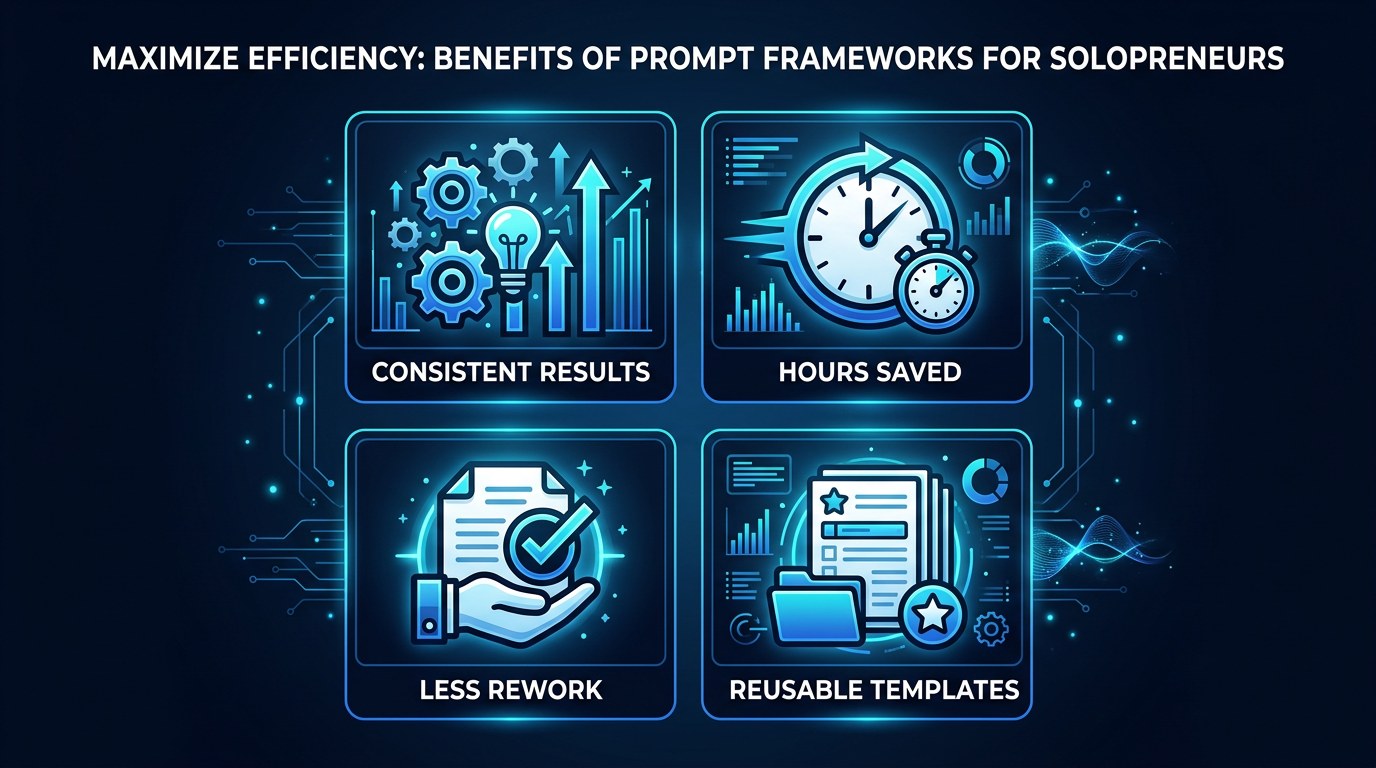
- Consistency: The same structure produces the same quality, every time.
- Speed: Filling in a template beats writing from scratch and rewriting.
- Less rework: Clear constraints up front means fewer "that's not what I meant" loops.
- Transferability: Good templates can be handed to a VA or contractor and still produce your standard.
Getting the Most Out of Prompt Frameworks
- Start a single "Prompts" doc today and add every prompt that works — your library compounds fast.
- When an answer misses, fix the prompt, not just the output, so the next run is better.
- Always include one example of what "good" looks like when style matters — it's the highest-leverage line in any prompt.
- Review your top 3 templates monthly and prune the parts the model ignores. For more workflow ideas, see our free tools collection.
Frequently Asked Questions About Prompt Frameworks
How do I start using prompt frameworks if I've never structured a prompt before?
Pick one framework — RTF is the easiest — and use it for everything this week. Just name the role, state the task, and specify the format every time. Once it feels automatic, add context and constraints to graduate to RACE.
What's the process for turning a good prompt into a reusable template?
When a prompt produces output you'd happily send, turn it into a template:
- Replace the specifics (names, topics, numbers) with blanks like [CLIENT] or [TOPIC].
- Keep the role, format, and constraint lines exactly as they were.
- Save it in one place with a clear label.
- Reuse it by filling the blanks instead of writing from scratch.
Can I use the same framework across different AI tools?
Yes, with a small caveat. Role, task, context, and format work across ChatGPT, Claude, Gemini, and most others because they all respond to clear structure. You may need to adjust length or phrasing slightly per tool, but the underlying framework transfers — build it once and reuse it everywhere.
Conclusion
Better AI results were never about finding a magic phrase. They're about giving the model the same clarity you'd give a sharp new assistant: who you are, what you need, and what good looks like. Once that becomes a habit, AI stops being a gamble and starts being something you can lean on — which, when you're running everything yourself, changes how much you can actually get done.
Start with the free AI Morning Brief at aiproductivitydaily.com/free-tools — a daily digest of what's moving in AI, filtered for solopreneurs.
One AI workflow, every weekday.
Tutorials, tool reviews, and automation playbooks for solopreneurs running on AI. Short, useful, and free. Unsubscribe anytime.
No pitch. No upsell. One quick AI workflow per weekday.