
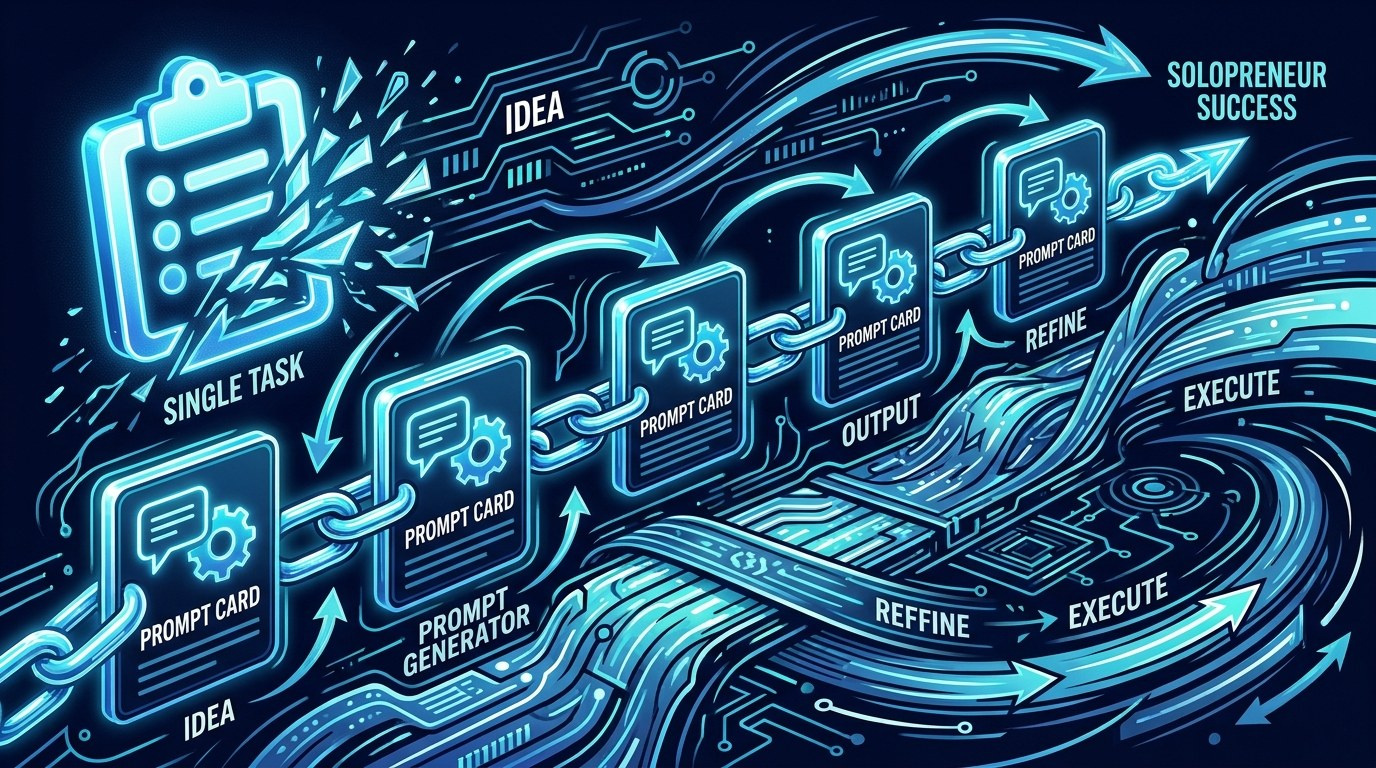
The Solopreneur's Guide to Prompt Chaining: Break Big AI Tasks Into a Sequence of Smart Prompts in 2026
What Every Solopreneur Needs to Know About Prompt Chaining
You ask AI to do something big in one shot—"write my entire launch email sequence and a matching landing page"—and you get back a wall of generic, half-right text you have to rewrite anyway. The problem usually is not the model. It is that you crammed five jobs into one prompt. Prompt chaining fixes this by splitting one large request into a short sequence of smaller prompts, where each step does a single job and hands its output to the next.
Here is what this guide covers:
- What prompt chaining actually is
- The core links in a chain
- Chaining vs. chain-of-thought
- When to chain vs. one-shot
- Reusable chains you can save
- Tools that run chains automatically
Before you build one, here are the core considerations to weigh:
- How many distinct steps your task needs
- Where errors tend to creep in
- Whether you will reuse the chain later
- How much control you want over each step
- Manual chaining vs. automated chaining
- Setup effort versus time saved
By the end, you will know how to turn a messy, do-it-all prompt into a clean, repeatable chain that produces sharper output with far less rework—and how to decide when chaining is overkill.
AI Productivity Daily, a resource for solopreneurs and small business owners using AI to save time and grow, has tested prompt chaining across content, research, and client-facing workflows. In this guide, I'll show you exactly how to build a chain, when to use one, and the quiet mistakes that cost you hours.
The Core Building Blocks of Prompt Chaining
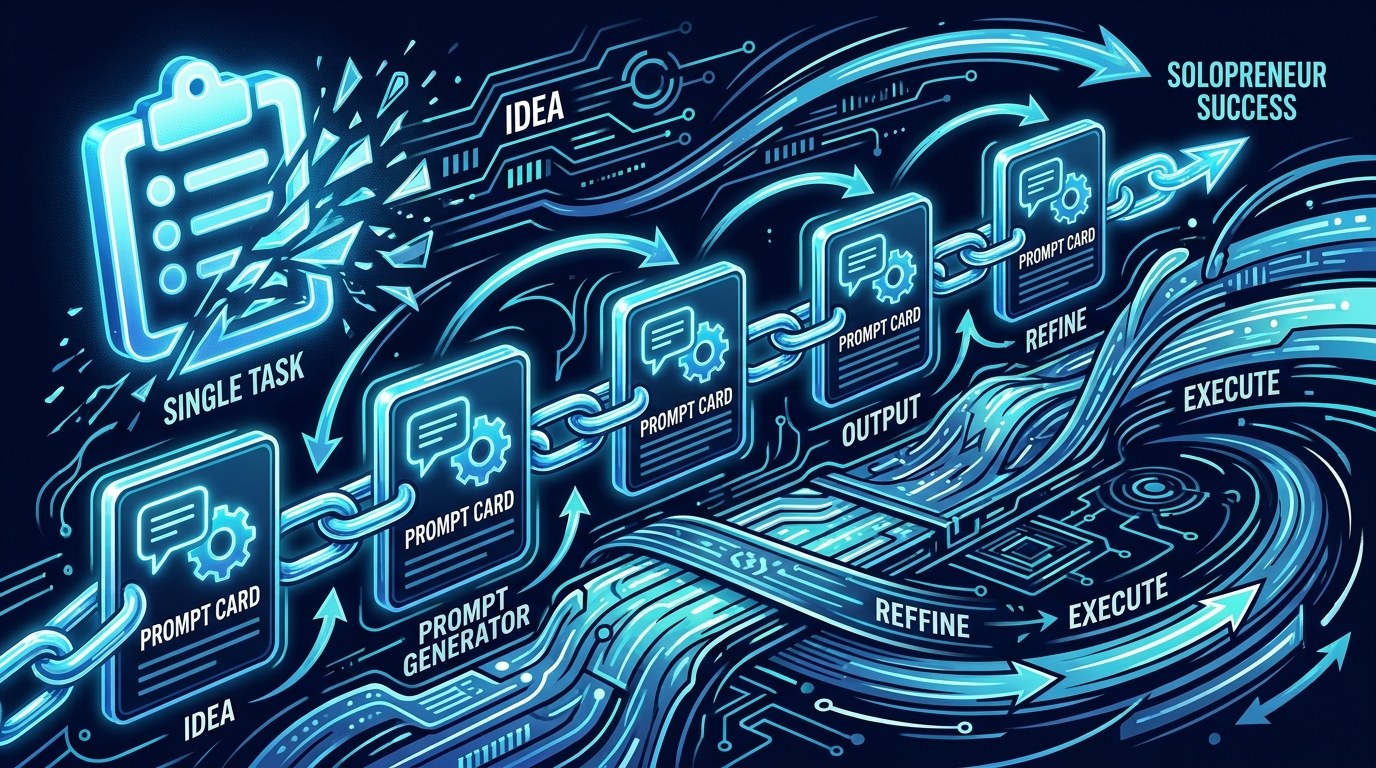
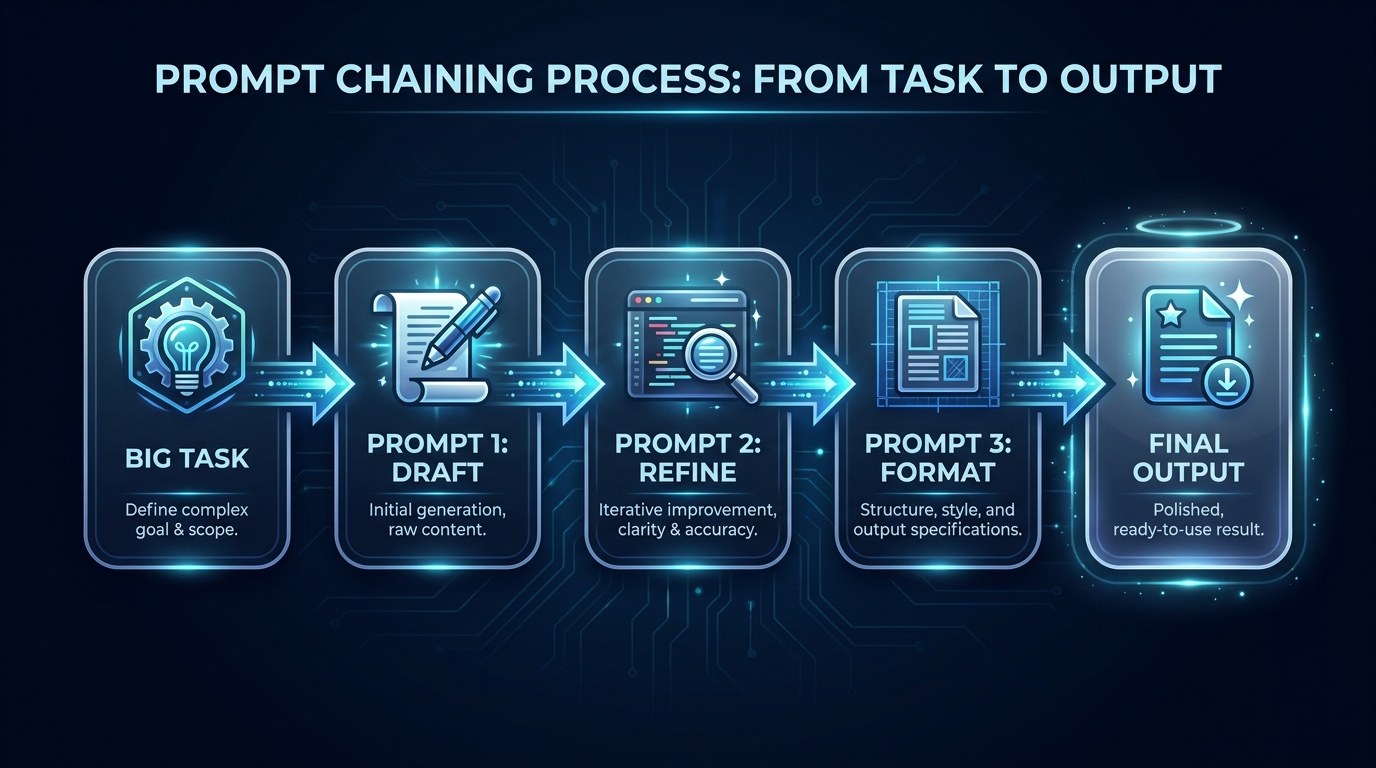
Prompt chaining is the practice of solving a complex task with several connected prompts instead of one giant request. The output of step one becomes the input to step two, and so on, until a polished result drops out the end. Think of it like an assembly line: each station adds one specific thing rather than trying to build the whole product at once.
This pattern has moved from a power-user trick to a default in 2026. Most of the AI products shipping this year—agents, research assistants, content tools—are chains under the hood, quietly routing your request through multiple model calls. The reason is simple and well documented across major AI labs: a model asked to do one clearly scoped job is far more reliable than the same model asked to juggle five instructions in a single breath. When you chain manually, you are borrowing that same reliability for your own work.
The Links in a Chain: One Job Per Prompt
The unit of a chain is a single prompt that does one job well. A good link in the chain shares a few traits, and once you can spot them, building chains becomes obvious.
- A single, clear goal: draft, summarize, critique, reformat—pick one verb per step.
- A defined input: the output from the previous step, pasted or passed in cleanly.
- A specified output format: bullets, a table, JSON, or a fixed word count so the next step can use it.
- An inspectable checkpoint: a moment where you can read the result and catch problems early.
That last trait is the quiet superpower. Because you can read the output between steps, you catch a wrong assumption at step two instead of discovering it buried in a finished draft at step five. For a solopreneur with no editor and no second set of eyes, those checkpoints are how you keep quality high without slowing to a crawl.
Prompt Chaining vs. Chain-of-Thought: Not the Same Thing
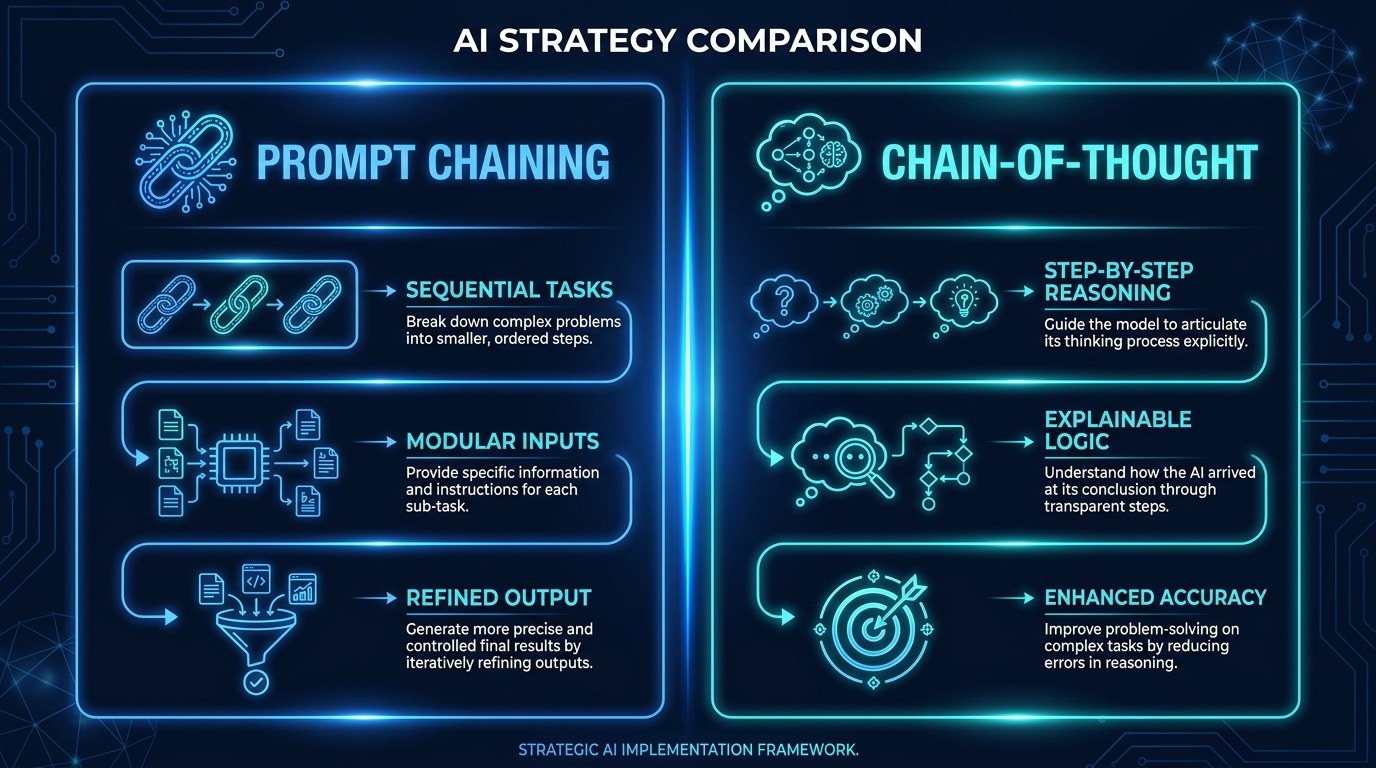
These two terms get mixed up constantly, and the confusion costs people good results. Chain-of-thought is about reasoning inside one prompt—you ask the model to "think step by step" so it shows its work before answering. Prompt chaining is about workflow across several prompts—you run multiple separate requests and pass results between them.
In 2026 the smartest setups use both: a single link in your chain might itself use chain-of-thought to reason carefully, while the chain as a whole moves the task from raw idea to finished asset. The practical benefit of knowing the difference is control. Chain-of-thought improves the quality of one answer; prompt chaining lets you inspect, correct, and reuse the path to a whole deliverable. Use the wrong one and you either get a single over-stuffed response or you split a task that never needed splitting.
How to Choose the Right Chaining Approach for Your Business
Not every task deserves a chain, and not every chain should be automated. The table below maps the main approaches so you can match the method to the job in front of you.
| Approach | Key Quality | Strengths | Best For | |---|---|---|---| | Single Mega-Prompt | Fast, one request | No setup, instant | Simple, one-step tasks | | Manual Prompt Chain | You run each step | Full control, easy to inspect | Complex one-off deliverables | | Saved Template Chain | Reusable prompt set | Consistency, fast restart | Tasks you repeat weekly | | Automated Chain (Zapier/Make/n8n) | Runs hands-free | Scale, no manual steps | High-volume, stable workflows | | Agentic Chain | AI plans the steps | Least effort, flexible | Open-ended research and ops |
If you only take one thing from this table, make it this: your default should be a manual chain that you save as a reusable template. It gives you the control and checkpoints of manual work the first time, and the speed of automation every time after—without the brittleness and debugging cost of a fully automated pipeline you have to maintain.
Worried Chaining Will Eat More Time Than It Saves? Practical Tips
It feels slower to write three prompts than one. In practice, a good chain pays for itself the second time you run it. Keep these in mind:
- Cap your first chain at 3 steps. Draft, refine, format covers most content jobs and takes under 10 minutes to build.
- Reuse before you automate. Run a chain manually at least 3 times before wiring it into a tool—you will spot the weak step.
- Name every step. A one-line label ("Step 2: tighten to 150 words") makes the chain reusable months later.
- Save the whole chain in one note. Store all prompts in a single document so you can rerun the sequence in under 60 seconds. If you are still building your prompt habit, start with reusable single prompts first—our guide to few-shot prompting is a good on-ramp before you string them together.
Linear Chains vs. Branching Chains — Understanding the Difference
A linear chain runs straight through: step one to two to three, no detours. It is the right shape for most solopreneur work because it is easy to read, easy to fix, and easy to hand to a tool later.
A branching chain splits based on a result—"if the draft is for LinkedIn, do this; if it is for email, do that." Branches add power but also complexity, and every branch is one more path you have to test. Reach for branching only when a single workflow genuinely serves two different outputs; otherwise, two clean linear chains beat one tangled branching one.
Prompt Chaining for Every Stage of Your Business
The right amount of chaining depends on where you are, not on how advanced you want to look.
- Just starting: You are still learning what good output looks like. Chain only your highest-stakes task—usually whatever you publish or send to clients—and keep everything else one-shot.
- Growing and repeatable: Patterns are emerging. Turn your three or four most-repeated tasks into saved template chains so quality stops depending on your energy that day.
- Scaling and delegating: You are handing work to a contractor or a tool. A documented chain becomes a training asset—anyone can run it and get your standard of output.
Beginner vs. Advanced Setups
You can run the exact same concept at three very different levels of effort.
- Beginner (free): Copy and paste between prompts inside one ChatGPT or Claude conversation. Zero tools, zero cost, full control. This is where everyone should start.
- Intermediate (low cost): Keep your chains in a notes app or a prompt manager, with each step labeled and ready to paste. The upgrade here is reusability—you stop rebuilding the chain every time.
- Advanced (paid tools): Run the chain automatically with Zapier, Make, or n8n so it fires on a trigger and delivers finished output. The extra cost is justified only once a chain is stable and you run it often enough that manual steps are the bottleneck.
Customization and Workflow Integration
In 2026, the line between "prompting" and "automation" has blurred—the same chain you run by hand can usually be dropped into an automation tool with almost no changes. That makes customization low-risk: build it manually, prove it works, then adapt it. Three practical ways to tailor a chain to your workflow:
- Inject your context once. Add a brand-voice or audience note as the first link so every later step inherits it.
- Swap the final formatting step. Keep the draft and refine steps fixed, and change only the last step to retarget the same content for email, social, or a blog.
- Add a review link. Insert a "critique this for accuracy and tone" step before the final output to catch issues automatically.
Why This Matters for Solopreneurs Running Lean in 2026
If you are running a business solo, your scarcest resource is not AI access—it is attention. The hesitation around chaining is understandable: it looks like more steps, more prompts, more to manage. But the framework flips that. A chain front-loads a little structure so that every future run is faster, steadier, and far less dependent on you being sharp in the moment.
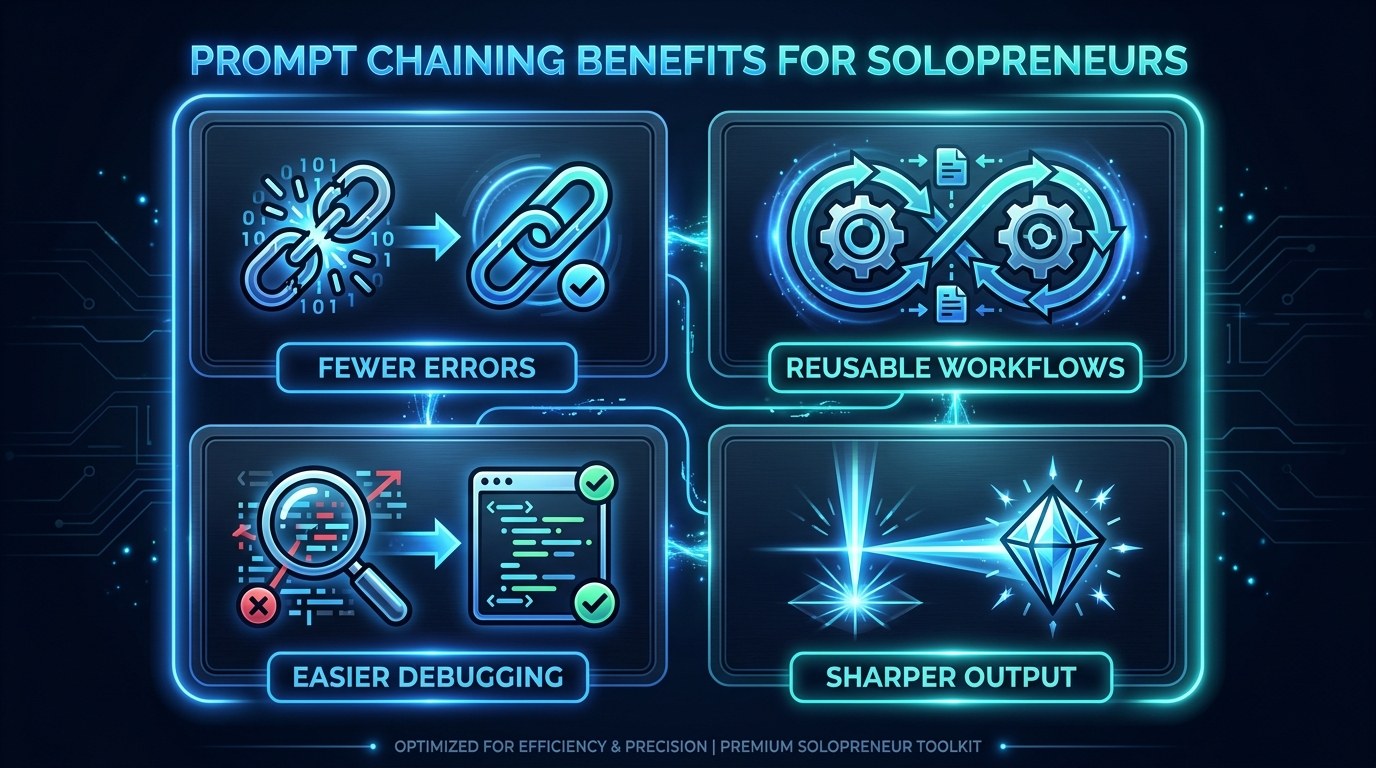
Applied to real work, prompt chaining gives a lean operator four concrete edges:
- Fewer errors: small, inspectable steps catch mistakes before they compound.
- Reusable workflows: build the chain once, rerun it in seconds for months.
- Easier debugging: when output is off, you know exactly which link to fix.
- Sharper output: each step does one job well instead of doing five jobs poorly.
Getting the Most Out of Prompt Chaining
A few insider habits separate a chain that saves time from one that quietly wastes it.
- End each step with the format the next step needs. If step three wants a table, make step two output one.
- Keep a "golden output" example. Save your best result so you can compare future runs and spot drift fast.
- Trim ruthlessly after three runs. If a step never changes the result, delete it—shorter chains are more reliable.
- Pair chaining with strong reasoning. Let individual links reason carefully; our breakdown of chain-of-thought prompting shows how to make each step think before it answers.
Frequently Asked Questions About Prompt Chaining
How do I start prompt chaining if I've never done it?
Pick one task you already do with AI and split it into three prompts: draft, refine, format. Run them one at a time in the same chat, pasting each result into the next prompt. That is a complete chain—you do not need any special tool to begin, just the discipline of one job per prompt.
What happens between each step in a chain?
Between steps, you (or a tool) move the output forward and check it. A clean handoff looks like this:
- Read the previous step's output and confirm it is usable.
- Fix or trim anything obviously wrong before continuing.
- Paste it into the next prompt as the labeled input.
- Run the next step and repeat until the final output.
That inspection moment is the whole point—it is where chains beat single mega-prompts.
Can I reuse the same chain for different projects?
Yes, and that is where most of the time savings live. Save the full sequence of prompts in one document and swap only the input and any context details for a new project. The caveat: re-read the output the first time you reuse a chain on a very different task, since a chain tuned for blog posts may need its final formatting step adjusted before it fits email or social.
Conclusion
Prompt chaining is not a more complicated way to use AI—it is a calmer one. Instead of gambling on a single giant prompt and editing the wreckage, you walk a task through a few clear steps you can see, fix, and reuse. The first chain takes ten minutes. Every chain after that hands you a finished result while you focus on the parts of your business only you can do.
If you want a steady stream of practical AI moves like this one, start with the free AI Morning Brief at aiproductivitydaily.com/free-tools—a daily digest of what's moving in AI, filtered for solopreneurs.
One AI workflow, every weekday.
Tutorials, tool reviews, and automation playbooks for solopreneurs running on AI. Short, useful, and free. Unsubscribe anytime.
No pitch. No upsell. One quick AI workflow per weekday.