
The Solopreneur's Guide to Self-Critique Prompting: Make AI Review and Improve Its Own Work in 2026
What Every Solopreneur Needs to Know About Self-Critique Prompting
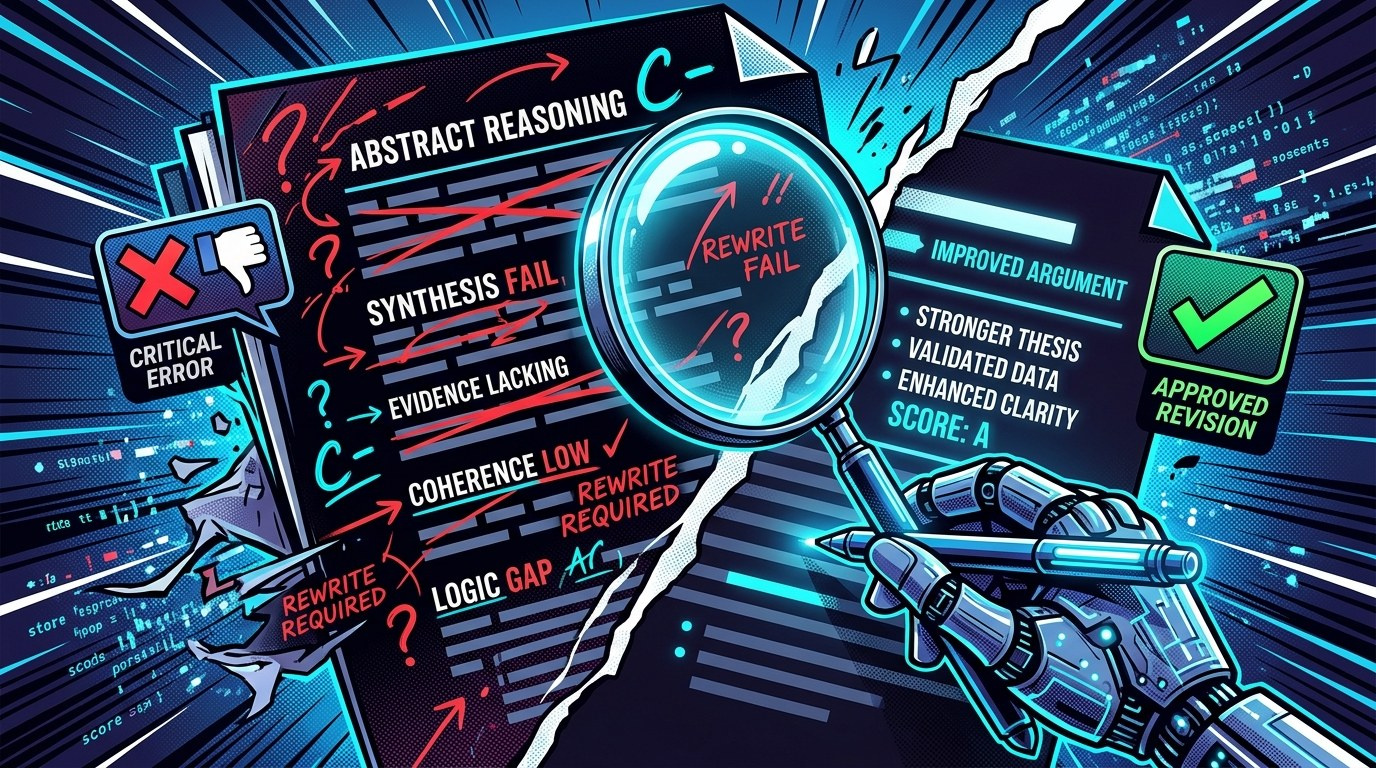
You ask AI for a sales page. You get something that is 70% there — competent, generic, slightly off. Then you spend forty minutes fixing it yourself. The problem is almost never the model. It is that you asked for one pass and accepted the first thing that came back.
Self-critique prompting fixes that by adding a step: before the model hands you anything, it evaluates its own draft against criteria you set, then rewrites it. Here is what this guide covers:
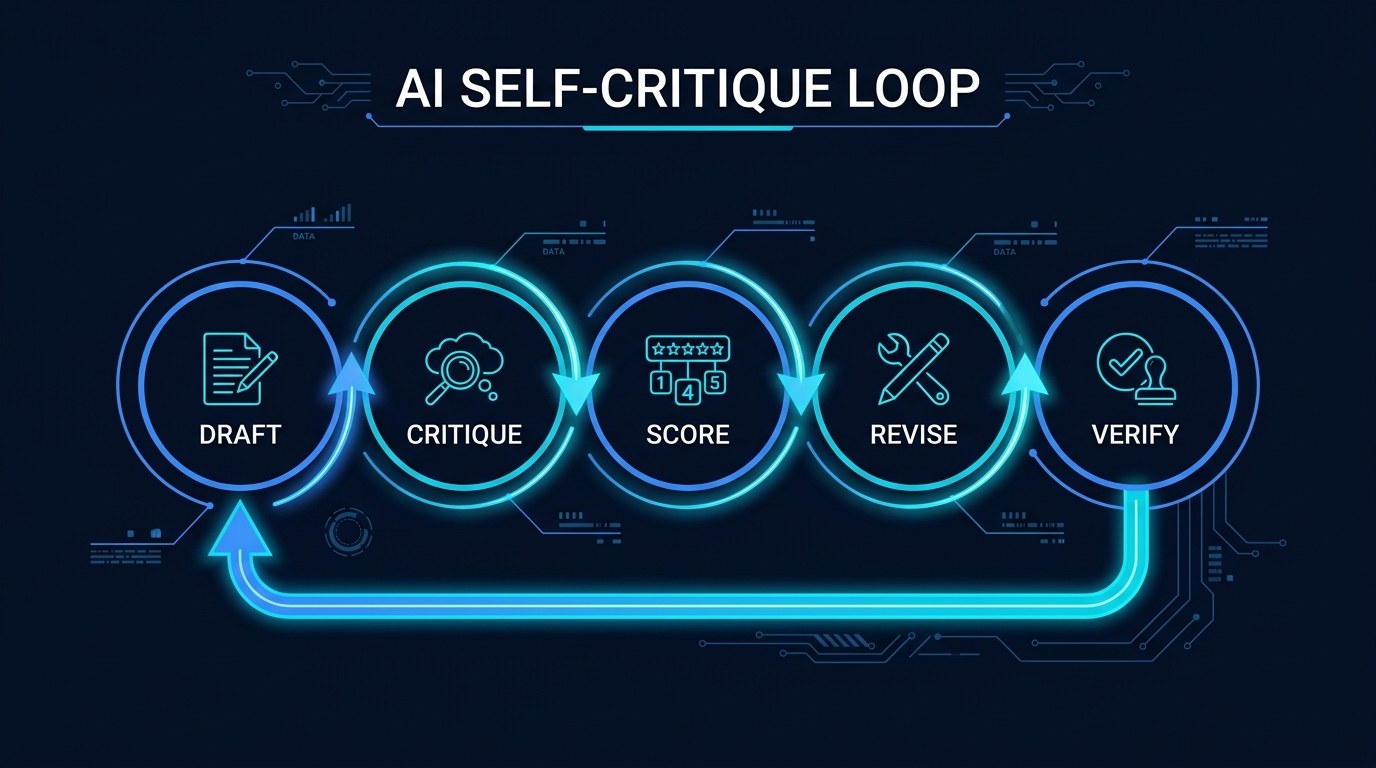
- The critique loop — draft, evaluate, score, revise
- Rubric prompting — grading against explicit criteria
- Adversarial review — asking AI to attack its own work
- Chained self-critique — multiple improvement passes
- Confidence flagging — surfacing what the model is unsure about
- Stop conditions — knowing when to quit revising
Before you build this into your workflow, weigh these:
- How many revision rounds actually improve output before quality plateaus
- Whether one long prompt or separate messages works better for your tool
- What "good" means for your business, in writing, not in your head
- Token and time cost versus the editing hours you save
- Which tasks genuinely benefit and which are fine on one pass
- How to stop the model from praising its own work instead of fixing it
By the end you will have a repeatable structure you can paste into any AI tool to get second-draft quality on the first delivery.
AI Productivity Daily, a resource for solopreneurs and small business owners using AI to save time and grow, has tested self-critique patterns across writing, analysis, and client-facing work. In this guide, I'll show you the exact prompt structures that work, when they are worth the extra tokens, and where they quietly fail.
The Core Mechanics of Self-Critique Prompting
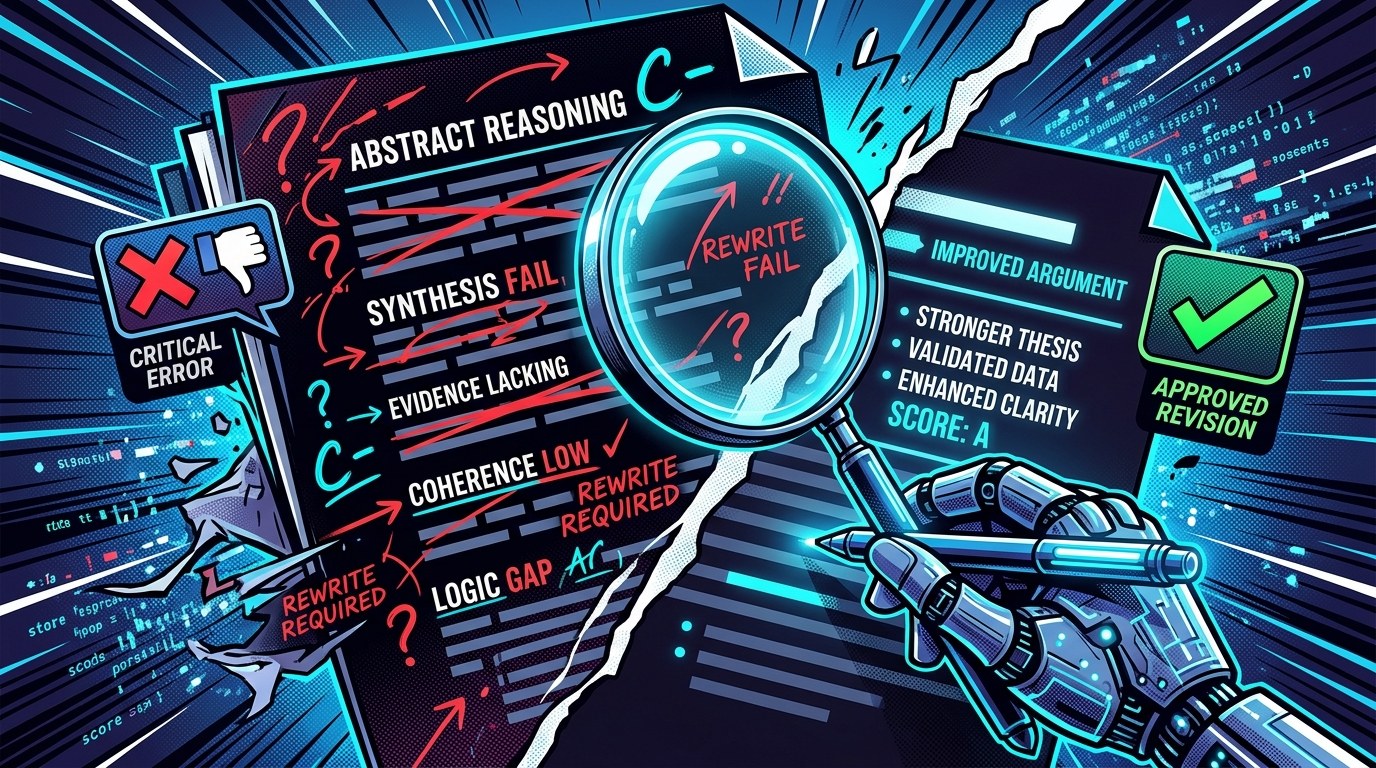
Every frontier model released through 2025 and into 2026 was trained with some form of reinforcement from feedback, which means these systems are considerably better at evaluating text than at producing perfect text on the first attempt. That gap is the entire opportunity. Research on self-refinement published across 2023 and 2024 consistently found meaningful quality gains when models were asked to critique and revise their own output rather than generate once — and reasoning-model releases through 2026 have made the effect more reliable, because the critique step now happens with actual deliberation behind it rather than pattern-matched agreement.
For a solopreneur, this matters in a very unglamorous way: you are the entire editorial department. Every hour you spend rewriting AI output is an hour not spent on the work only you can do. Self-critique moves that editing pass upstream, into the model, where it costs you seconds instead of an afternoon.
The Critique Loop — How It Actually Works
The pattern is simple enough to memorize. You ask for a draft, then in the same prompt or a follow-up, you ask the model to evaluate that draft against explicit criteria and produce a revised version. The critical detail is that the criteria must be yours and must be specific — "make it better" produces cosmetic changes, while "check whether every claim is supported and cut any sentence that does not advance the argument" produces real edits.
Here is what to include in any critique instruction:
- Named criteria — three to five specific quality dimensions, not vague adjectives like "engaging" or "professional"
- A scoring requirement — force a number, 1 to 10, per criterion, so weak areas get identified rather than glossed over
- A revision mandate — explicitly say "now rewrite it," because models will otherwise stop at the critique and hand you a report instead of a better draft
- A no-praise rule — instruct it to skip what works and list only what fails, or you will get a paragraph of self-congratulation
The payoff is that you receive something closer to a second or third draft. You are still the final editor, but you are editing something worth editing.
Why Reasoning Models Changed the Math
Through 2026, most major assistants now expose some form of extended reasoning — the model thinks before it answers. This changed self-critique from a nice trick into a genuinely reliable technique, because earlier models had a well-documented tendency toward sycophancy: asked to critique their own work, they would find it excellent. Reasoning models are markedly more willing to identify real problems, especially when the prompt explicitly authorizes harsh feedback.
There is a practical consequence here. On a reasoning-capable model, a single well-constructed self-critique prompt often outperforms three rounds of manual back-and-forth. On a fast, non-reasoning model, you will get better results by splitting the critique into a separate message so the model is not trying to generate and evaluate in one continuous pass. Test both in whatever tool you use — the difference is usually obvious within two attempts.
For a solopreneur writing client proposals, this is the difference between sending a proposal you had to substantially rewrite and sending one you skimmed and approved. Same tool, same twenty minutes of your attention, materially different output.
How to Choose the Right Self-Critique Approach for Your Business
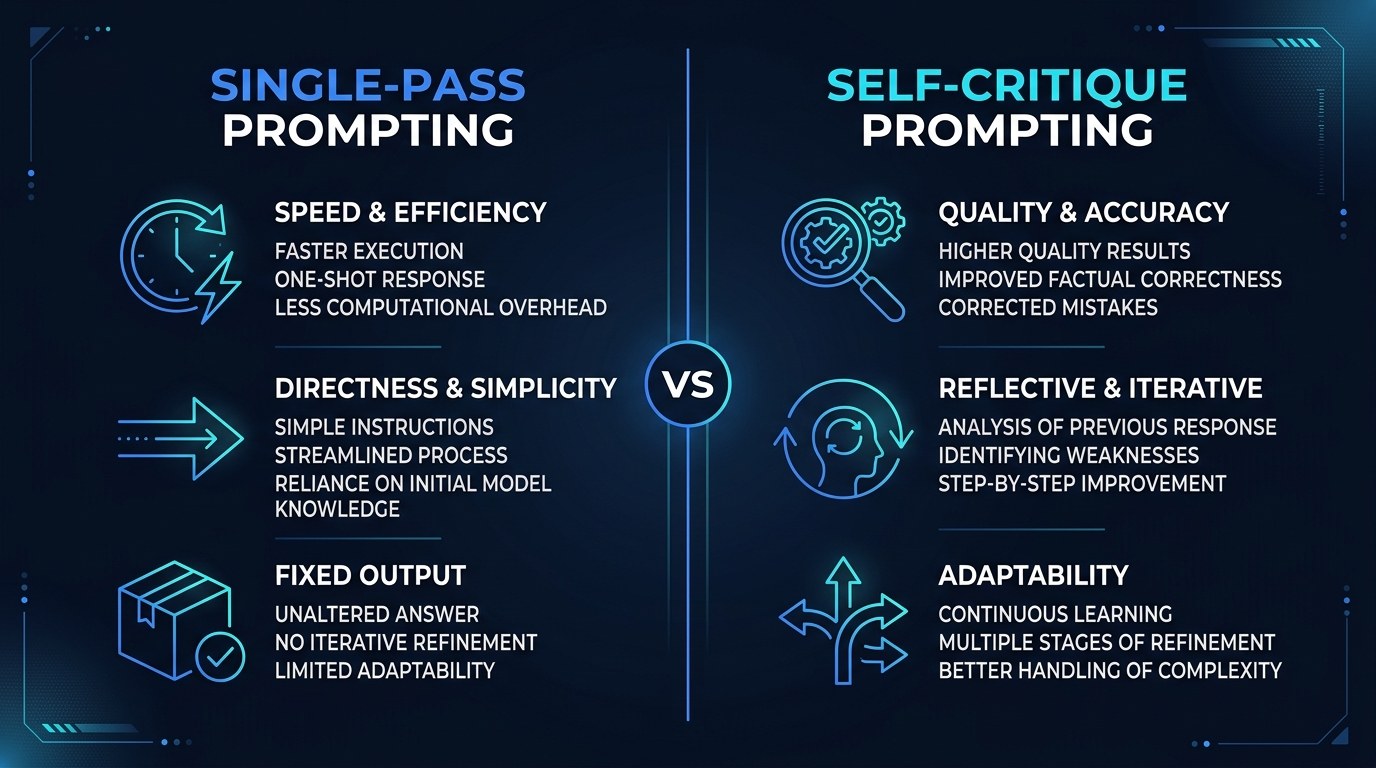
Not every task deserves a critique pass. Here is how the main patterns compare:
| Approach | Key Quality | Strengths | Best For | |---|---|---|---| | Rubric critique | Scores against named criteria | Consistent, repeatable, easy to template | Client deliverables, sales copy, proposals | | Adversarial review | Attacks the draft's weakest claim | Surfaces logical holes and weak evidence | Strategy docs, pitches, pricing arguments | | Chained refinement | Two or three sequential passes | Highest ceiling on quality | Cornerstone content, landing pages | | Confidence flagging | Marks uncertain claims | Catches hallucinated facts and numbers | Research summaries, competitive analysis | | Single pass (no critique) | Fast and cheap | Lowest cost and latency | Internal notes, drafts you'll rewrite anyway |
If you adopt one and only one, make it rubric critique. It is the most defensible choice because it is the only pattern that forces the model to be specific about where the draft is weak. Adversarial review is sharper but noisier; chained refinement produces the best output but hits diminishing returns fast. Rubric critique gives you roughly eighty percent of the benefit for a fraction of the complexity, and it templates cleanly — write the rubric once, reuse it forever.
"Won't This Just Waste My Time and Tokens?" — Practical Tips
The honest answer is that it can, if you apply it indiscriminately. Here is how to keep it efficient:
- Cap it at two revision passes. Quality gains fall off sharply after the second pass in most testing — a third round tends to produce lateral changes rather than improvements, and occasionally makes the draft worse by over-hedging.
- Write your rubric once and save it. Build a three-to-five criterion rubric for each recurring task type — sales email, client proposal, blog intro — and keep it in a notes file. Reusing a saved rubric takes about ten seconds versus five minutes of rethinking criteria each time.
- Skip critique on anything under 150 words. Short outputs rarely have enough structure for the critique step to find real problems, and you will burn tokens confirming that a two-sentence reply is fine.
- Add "be harsh" explicitly. A single instruction like "you are a demanding editor; do not praise anything, list only what fails" changes output quality more than any other adjustment. Without it, expect gentle, useless feedback.
For more prompt structures you can reuse across your whole workflow, the free tools library at aiproductivitydaily.com collects the templates worth keeping.
Self-Critique vs. Chain-of-Thought — Understanding the Difference
These get conflated constantly, and they solve different problems. Chain-of-thought prompting improves how a model arrives at an answer — it reasons step by step before responding, which helps with math, logic, and multi-constraint problems. Self-critique operates after an answer exists: it evaluates finished output and revises it.
The practical rule is that chain-of-thought helps when the problem is hard, and self-critique helps when the output is long. A pricing calculation benefits from reasoning; a 1,200-word sales page benefits from critique. Many tasks want both — reason your way to a good structure, then critique the draft it produced. Choose based on whether your failure mode is wrong thinking or sloppy execution.
Self-Critique for Every Stage of Your Business
- Solo consultant sending proposals. Every proposal is a revenue event. A rubric critique checking for specificity, addressed objections, and a clear next step turns a template into something that reads as written for that client.
- Content-driven business publishing weekly. Volume is the constraint. Self-critique lets you keep quality steady at higher output, because the editing standard lives in a saved rubric rather than in how tired you are on a Thursday afternoon.
- Service business handling client communication. Difficult emails — scope pushback, late payment, a mistake you need to own — benefit enormously from an adversarial pass asking "how could this be misread?" before you send.
Beginner vs. Advanced Options
Where to start depends on how much prompt structure you are already comfortable with:
- Beginner — the one-line add-on. Append "Now critique this draft against clarity, specificity, and persuasiveness. Score each 1-10, then rewrite it fixing anything below 8." Right for anyone who has never built a structured prompt. Costs nothing to try and works in every major tool.
- Intermediate — the saved rubric. Build task-specific rubrics with four to five criteria and store them alongside your other templates. The meaningful upgrade here is consistency: the same standard applies whether it is Monday morning or Friday night. Best for anyone producing client work weekly.
- Advanced — chained critique with a stop condition. Two passes, with an explicit instruction to stop revising once all criteria score 8 or above. Justifies the extra setup when the output is high-stakes — a landing page, a pitch deck narrative, cornerstone content that will run for a year.
Customization and Workflow Integration
The trend through 2026 has been toward persistent instructions — custom instructions, project-level context, saved system prompts — which means you no longer have to paste your critique structure into every conversation. Set it once at the project level and it applies to everything inside it.
- Bake the rubric into a saved project or custom instruction so critique happens by default on every draft, without you asking
- Attach a brand voice document and add "consistency with the attached voice guide" as a scored criterion, which catches drift better than any adjective you could write
- Vary the critic persona by task — a skeptical buyer for sales copy, a technical reviewer for documentation, a time-pressed executive for anything over a page
Why This Matters for Solopreneurs Running Lean in 2026
If you have tried AI writing tools and quietly concluded the output is not good enough to use unedited, you are not wrong — but you may have been testing the wrong thing. You were testing first drafts. Nobody sends first drafts. The reason AI output feels mediocre is that most people never ask for the second draft, and the second draft is where the technique actually pays off.
Here is what changes when you build critique into your default workflow:
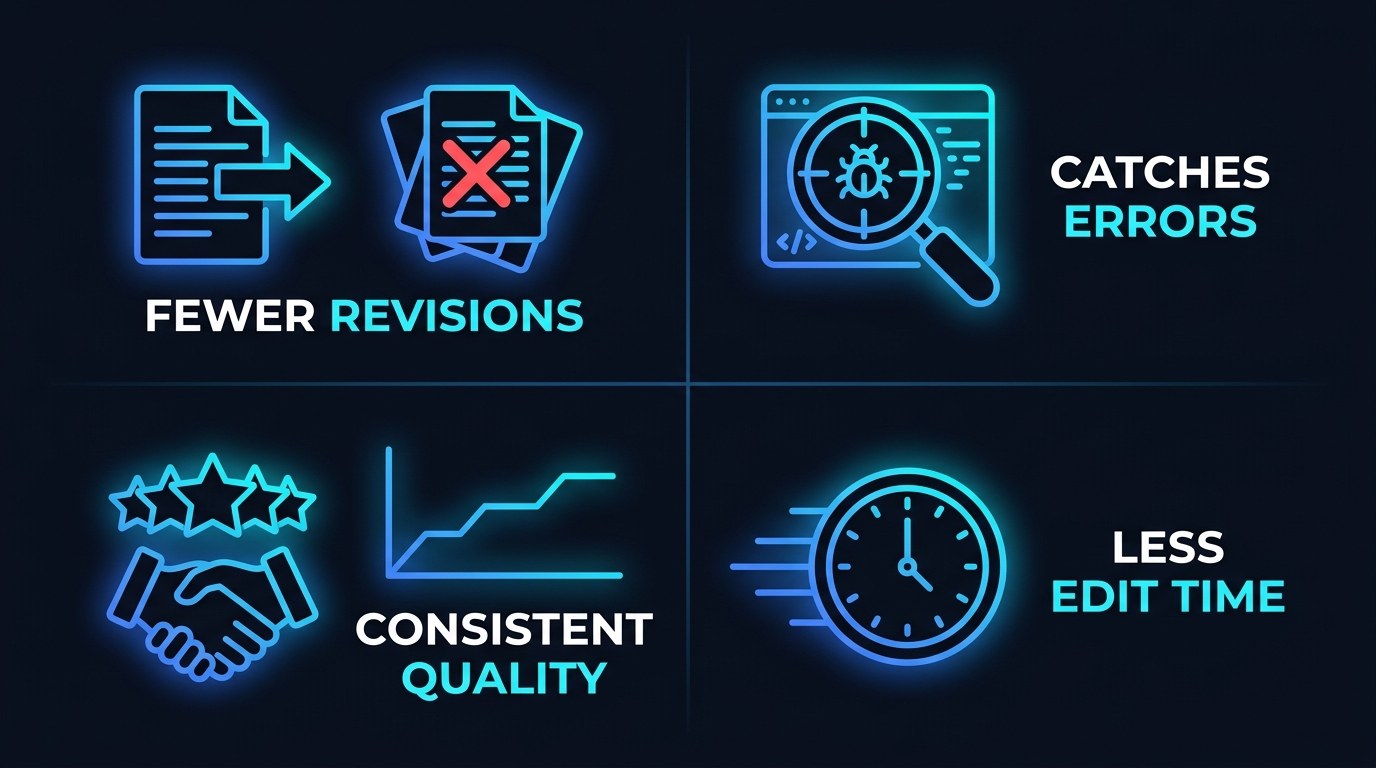
- Editing time drops meaningfully because you are correcting a revised draft rather than reconstructing a rough one
- Quality stops depending on your energy level — the rubric enforces the standard whether you are sharp or exhausted
- Factual errors surface earlier, since confidence flagging catches invented statistics before they reach a client
- Your standards become portable — a written rubric is an asset you can reuse, refine, and eventually hand to a contractor
Getting the Most Out of Self-Critique Prompting
- Name the critic. "You are a direct-response copywriter who has launched 200 campaigns" produces sharper critique than "review this." Specific expertise pulls specific standards.
- Ask for the weakest sentence by name. Requiring the model to quote the single worst line in the draft forces engagement with the actual text instead of generic commentary.
- Require a diff summary. Add "list what you changed and why in three bullets" so you can spot when the model revised in the wrong direction and correct it in one message.
- Run critique in a fresh context for high-stakes work. Paste the draft into a new conversation with no memory of writing it — the model evaluates far more honestly when it is not defending its own work.
Pair this with the prompt structures in the free tools library and you have most of what a small business actually needs from prompt engineering.
Frequently Asked Questions About Self-Critique Prompting
How do I write a critique rubric that actually works?
Pick three to five criteria that describe what failure looks like for that specific task, not what success looks like in general. For a sales email, "does not address the obvious objection" is a usable criterion; "engaging" is not. Force a numeric score per criterion so weak areas get named rather than averaged away.
What happens if the AI just says the draft is great?
That means your prompt was too polite. Fix it in this order:
- Add an explicit instruction: "do not praise anything, list only failures"
- Give the critic a demanding persona with relevant expertise
- Require it to quote the weakest sentence verbatim
- Move the critique to a fresh conversation where the model has no authorship attachment
Can I use this for things other than writing?
Yes, with one caveat. It works well for analysis, strategy documents, code review, and structured research, because those have criteria you can articulate. It works poorly for tasks with a single verifiable right answer — a calculation, a lookup, a date — where the model will either be correct or confidently wrong, and critique will not reliably catch the difference. For factual work, verify against a source instead.
Conclusion
The gap between AI output that feels disposable and AI output you would actually put your name on is usually one revision pass. Not a better model, not a longer prompt, not a paid tier — one deliberate step where you ask the system to hold its own work to a standard you defined. That is a remarkably small change for how much it shifts what these tools are worth to a business with no editorial team.
Start with the free AI Morning Brief at aiproductivitydaily.com/free-tools — a daily digest of what's moving in AI, filtered for solopreneurs.
One AI workflow, every weekday.
Tutorials, tool reviews, and automation playbooks for solopreneurs running on AI. Short, useful, and free. Unsubscribe anytime.
No pitch. No upsell. One quick AI workflow per weekday.